Textile Catalase Enzyme Industry: Specification Checklist for Bleach Cleanup
Compare catalase enzyme specs for textile bleach cleanup: pH, temperature, dosage, QC checks, COA/TDS/SDS, pilot validation, and cost-in-use.
For textile mills comparing catalase suppliers, the right specification is not only activity units. It is performance under real bath conditions, verified peroxide removal, documentation quality, and cost-in-use.
What Catalase Does in Textile Bleach Cleanup
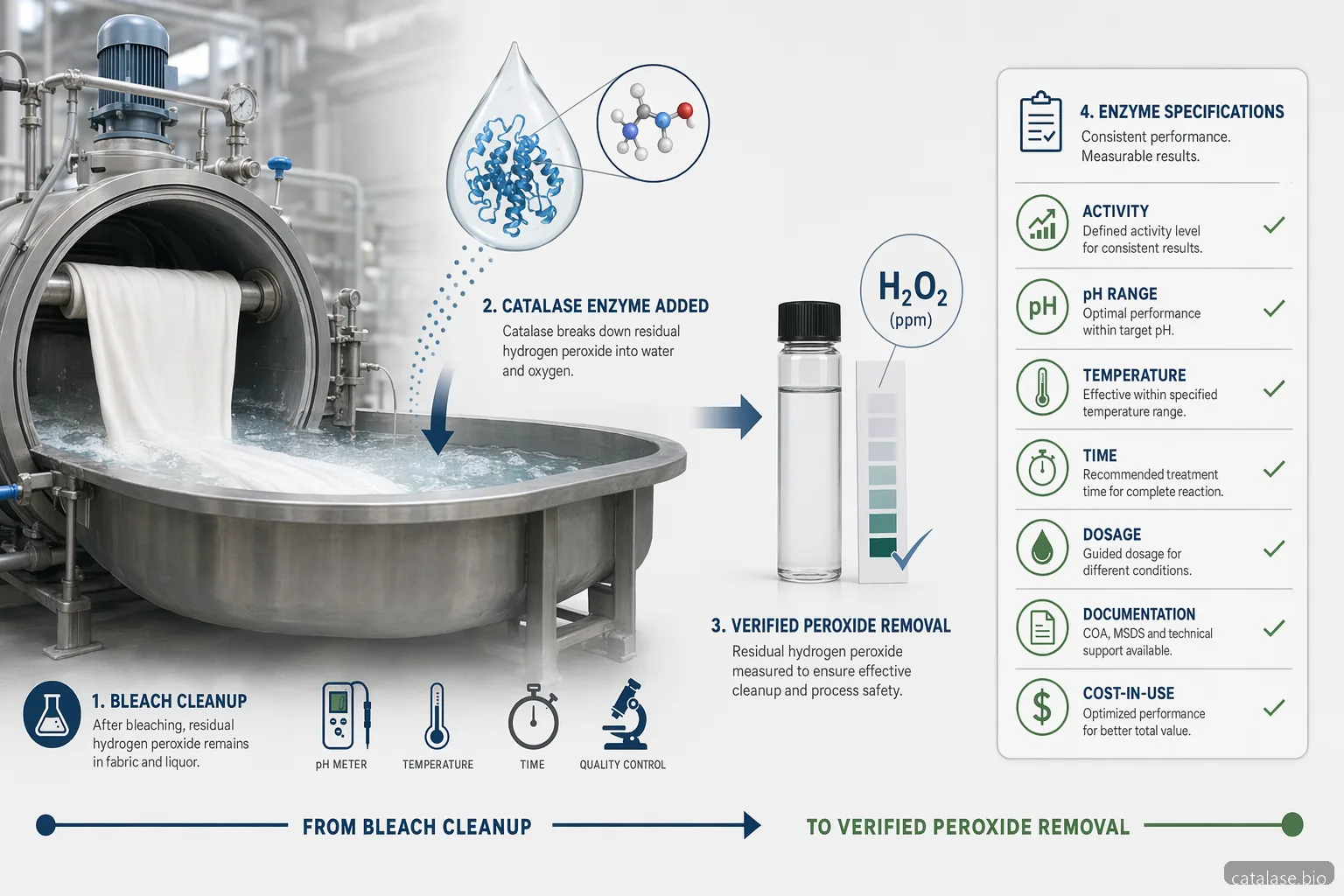
What is catalase enzyme in a textile process? Catalase is an enzyme that catalyzes the decomposition of hydrogen peroxide, its primary substrate, into water and oxygen. In cotton and blended fabric preparation, residual peroxide after bleaching can interfere with reactive dyes and other color systems. A textile catalase enzyme treatment is used after bleaching and rinsing, before dyeing, to reduce peroxide without adding sulfur-based reducing agents or excessive water. For buyers comparing enzymes and catalase suppliers, the application target is simple: achieve reliable hydrogen peroxide removal within the mill’s normal pH, temperature, liquor ratio, and cycle time. However, the specification must be process-specific. A catalase enzyme that performs well in a lab buffer may not deliver the same result in an alkaline bath with surfactants, salts, stabilizers, and variable fabric load. This is why pilot validation and peroxide testing are essential before scale-up.
Primary function: hydrogen peroxide removal after bleaching • Typical use point: before dyeing or finishing where peroxide is harmful • Output of reaction: water and oxygen, not a reducing salt residue
Core Specification Items for Industrial Buyers
A strong textile catalase enzyme industry comparison starts with documentation. Request the technical data sheet for recommended pH, temperature, dosing range, hold time, storage, and compatibility notes. The certificate of analysis should identify batch number, activity, appearance, and any defined quality parameters used by the supplier. The safety data sheet should support handling, storage, spill response, and transport review. Activity units are useful only when the assay method is understood, because catalase activity can be reported using different internal or industry methods. Buyers should also ask whether the product is formulated as liquid or granule, whether it contains stabilizers, and how viscosity or dosing pump compatibility is managed. For textile bleach cleanup, prioritize fit to plant conditions over headline activity. A lower-activity product with better stability in your bath can sometimes deliver lower cost-in-use than a higher-activity product that requires narrow controls.
Ask for COA, TDS, and SDS before commercial trials • Confirm activity assay method and unit definition • Review formulation format, storage life, and dosing compatibility • Compare performance in bath conditions, not only enzyme units
Process Conditions: pH, Temperature, Time, and Dosage
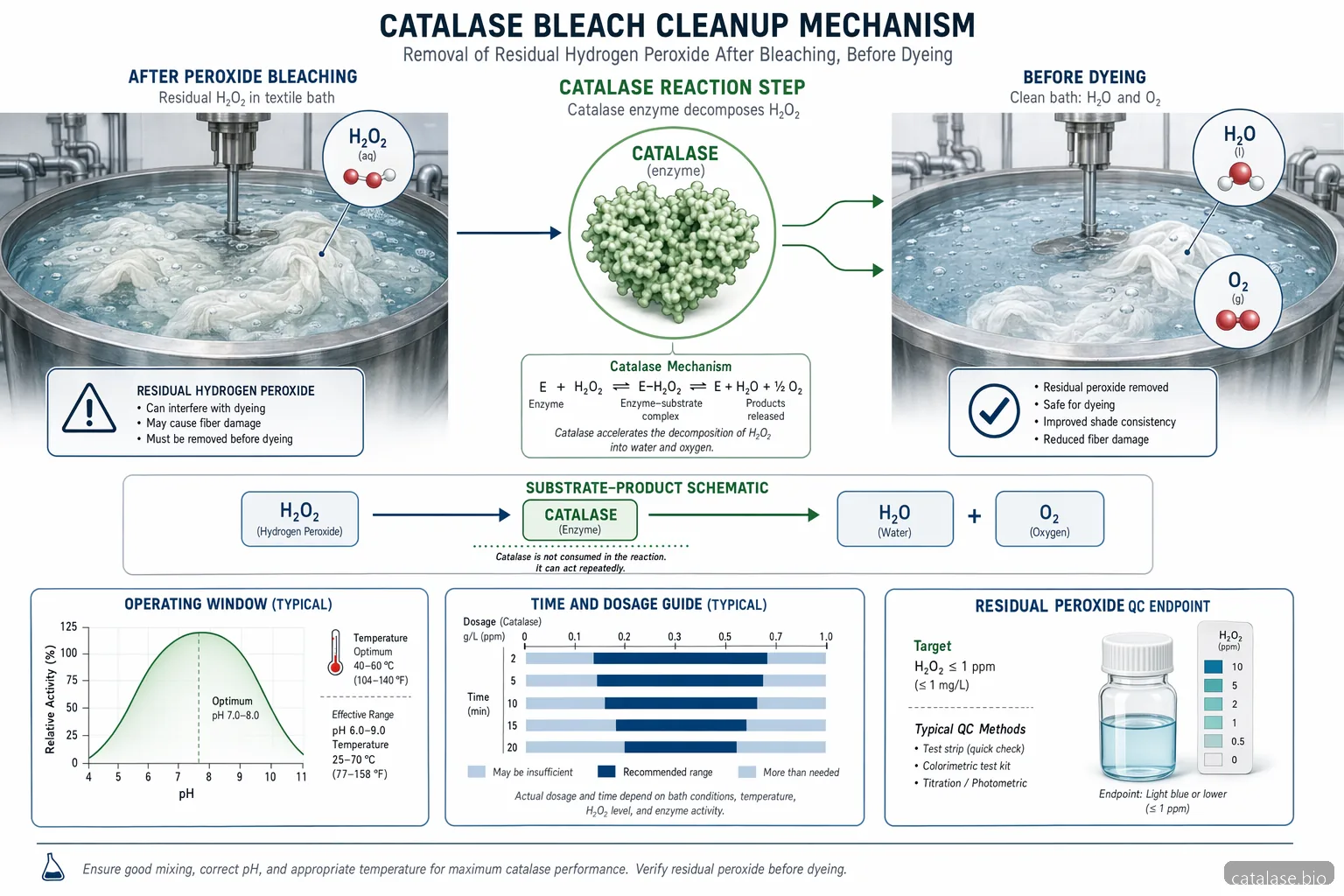
Typical textile catalase enzyme treatments are run after the bleaching step, often after partial draining or rinsing to bring peroxide, alkalinity, and temperature into the enzyme’s recommended window. Many industrial catalase products are designed to work around neutral to mildly alkaline pH, commonly about pH 6 to 9, although supplier-specific ranges vary. Practical operating temperatures often fall around 30 to 60°C, with some products tolerating higher or lower conditions for limited periods. Dosage may be expressed as grams or milliliters per liter, percent on weight of fabric, or units per gram of residual peroxide. A starting evaluation band may be about 0.05 to 0.30% owf or an equivalent supplier-recommended liquid dosage, then optimized by residual peroxide testing. Hold times commonly range from 10 to 20 minutes, but fabric load, liquor ratio, peroxide level, and mixing efficiency can shift the result.
Validate actual working pH and temperature at the machine • Optimize dosage against residual peroxide, not only bath recipe • Check mixing, liquor ratio, and fabric loading during trials • Avoid exceeding supplier limits for temperature or pH
QC Checks for Hydrogen Peroxide Removal
The central question, what does the enzyme catalase do, should be answered with plant QC data. Before dyeing, mills typically verify residual hydrogen peroxide using peroxide test strips, titration, or validated instrumental methods. Test both bath liquor and fabric carryover where applicable, because peroxide retained in fabric can still affect shade. Establish an internal release limit based on the dye class and shade sensitivity; for some operations, the target may be near non-detect by the chosen method, while other processes may tolerate a defined low residual level. Record incoming peroxide level, catalase dosage, pH, temperature, treatment time, and final peroxide result. During supplier comparison, run side-by-side trials under the same conditions. If peroxide removal is inconsistent, investigate bath pH, residual caustic, stabilizer chemistry, temperature drift, enzyme age, and dosing pump accuracy before changing the entire process.
Use peroxide strips, titration, or a validated mill method • Test liquor and fabric carryover when peroxide risk is high • Define release limits before dyeing • Document parameters for every pilot and production trial
Cost-in-Use and Supplier Qualification
A textile catalase enzyme industry report or supplier comparison should not rank products by price per kilogram alone. Cost-in-use includes dosage required to reach the peroxide target, treatment time, rework reduction, rinse water savings, utility impact, inventory stability, and production reliability. Ask suppliers to support a controlled pilot on representative fabrics, including high and low peroxide loads. Require batch traceability, clear complaint handling, change notification practices, and reasonable lead-time transparency. Supplier qualification should also review technical service capability: can the supplier interpret failed peroxide removal, recommend pH adjustment, and help optimize dosage without overfeeding? Avoid unverifiable claims and focus on measurable outcomes. The best catalase enzyme supplier for a mill is the one that provides consistent batches, complete documentation, practical process guidance, and a formulation that performs at the plant’s real operating window.
Compare total cost per treated fabric weight or machine batch • Include time, water, energy, rework, and shade reliability • Run controlled pilot validation before approval • Qualify suppliers on documentation, traceability, and technical support
Technical Buying Checklist
Buyer Questions
Yes. Catalase is an enzyme used in textile processing to decompose residual hydrogen peroxide after bleaching. In this industrial context, enzyme catalase is selected for bath compatibility, activity, stability, dosage efficiency, and consistent peroxide removal. Buyers should evaluate it through COA, TDS, SDS, pilot trials, and residual peroxide QC rather than relying only on generic activity claims.
The enzyme catalase converts hydrogen peroxide into water and oxygen. After textile bleaching, this helps reduce peroxide carryover before dyeing, where peroxide can cause shade variation or dye performance issues. The effectiveness depends on pH, temperature, peroxide load, treatment time, liquor ratio, and mixing. Final acceptance should be verified by peroxide strips, titration, or another validated mill method.
Compare suppliers on technical fit and cost-in-use, not only price per kilogram. Request COA, TDS, SDS, activity method, storage guidance, and batch traceability. Then run controlled pilot validation on representative fabrics and peroxide loads. Measure final residual peroxide, cycle time, dosage, shade outcomes, and any rework reduction. A qualified supplier should provide practical support for process optimization.
Many textile catalase products are evaluated around pH 6 to 9 and about 30 to 60°C, but the exact range depends on the enzyme formulation. The safest approach is to confirm the supplier’s TDS and validate in the actual machine. Residual caustic, stabilizers, surfactants, salts, and high temperature can all affect catalase enzyme performance.
Dosage should be set by the supplier’s recommendation and then optimized by plant trials. Some evaluations may begin around 0.05 to 0.30% on weight of fabric or an equivalent liquid dosage, but peroxide load and process conditions matter. The correct dose is the lowest reliable dose that meets the mill’s residual peroxide release limit before dyeing.
Catalase for Research & Industry
Need Catalase for your lab or production process?
ISO 9001 certified · Food-grade & research-grade · Ships to 80+ countries
Frequently Asked Questions
Is catalase an enzyme used in textile processing?
Yes. Catalase is an enzyme used in textile processing to decompose residual hydrogen peroxide after bleaching. In this industrial context, enzyme catalase is selected for bath compatibility, activity, stability, dosage efficiency, and consistent peroxide removal. Buyers should evaluate it through COA, TDS, SDS, pilot trials, and residual peroxide QC rather than relying only on generic activity claims.
What does the enzyme catalase do after bleaching?
The enzyme catalase converts hydrogen peroxide into water and oxygen. After textile bleaching, this helps reduce peroxide carryover before dyeing, where peroxide can cause shade variation or dye performance issues. The effectiveness depends on pH, temperature, peroxide load, treatment time, liquor ratio, and mixing. Final acceptance should be verified by peroxide strips, titration, or another validated mill method.
How should a mill compare catalase enzyme suppliers?
Compare suppliers on technical fit and cost-in-use, not only price per kilogram. Request COA, TDS, SDS, activity method, storage guidance, and batch traceability. Then run controlled pilot validation on representative fabrics and peroxide loads. Measure final residual peroxide, cycle time, dosage, shade outcomes, and any rework reduction. A qualified supplier should provide practical support for process optimization.
What pH and temperature are typical for textile catalase?
Many textile catalase products are evaluated around pH 6 to 9 and about 30 to 60°C, but the exact range depends on the enzyme formulation. The safest approach is to confirm the supplier’s TDS and validate in the actual machine. Residual caustic, stabilizers, surfactants, salts, and high temperature can all affect catalase enzyme performance.
What dosage should be used for hydrogen peroxide removal?
Dosage should be set by the supplier’s recommendation and then optimized by plant trials. Some evaluations may begin around 0.05 to 0.30% on weight of fabric or an equivalent liquid dosage, but peroxide load and process conditions matter. The correct dose is the lowest reliable dose that meets the mill’s residual peroxide release limit before dyeing.
Related: Catalase for Textile Bleach Cleanup — Hydrogen Peroxide Removal Before Reactive Dyeing
Turn This Guide Into a Supplier Brief Request a textile catalase specification review and pilot trial plan for your bleach cleanup process. See our application page for Catalase for Textile Bleach Cleanup — Hydrogen Peroxide Removal Before Reactive Dyeing at /applications/catalase-textile-bleach-cleanup/ for specs, MOQ, and a free 50 g sample.
Contact Us to Contribute