Catalase Enzyme for Textile Bleach Cleanup
Buy catalase enzyme for textile peroxide removal. Compare specs, dosage, pH, temperature, QC checks, COA/TDS/SDS, and supplier validation.
Source industrial catalase for reliable hydrogen peroxide removal after bleaching, with practical guidance on operating conditions, validation, QC, and cost-in-use.
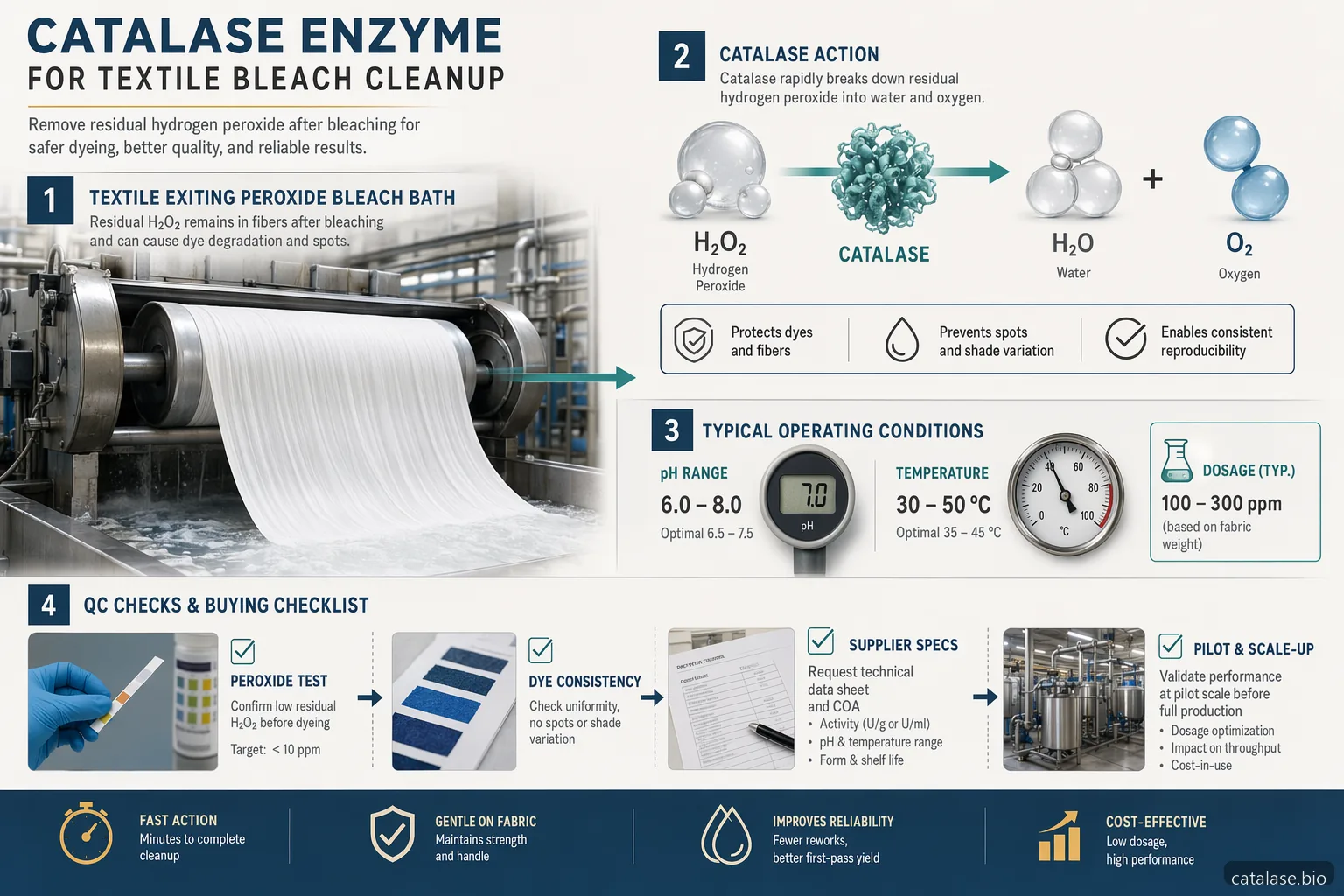
Why Textile Mills Use Catalase After Peroxide Bleaching
Hydrogen peroxide bleaching is effective for cotton, linen, blends, and many knitted or woven goods, but residual peroxide can interfere with dye uptake, shade reproducibility, and downstream chemistry. Catalase enzyme is used to break down remaining peroxide quickly before dyeing or finishing, reducing the need for repeated hot rinsing. For buyers asking what does the enzyme catalase do, the practical answer is simple: it converts hydrogen peroxide into water and oxygen under controlled process conditions. In textile bleach cleanup, this can shorten cycle time, lower water demand, and improve process consistency when validated correctly. The value is highest where mills handle frequent shade changes, sensitive dyes, or tight right-first-time targets. Catalase does not replace good bleaching control; it is a targeted peroxide removal step that should be matched to the mill’s pH, temperature, substrate load, and equipment.
Primary use: residual hydrogen peroxide removal after bleaching • Common position: after drain or rinse, before dyeing • Key outcome: peroxide level reduced to the dyehouse target
What Is Catalase Enzyme in Industrial Buying Terms?
If your team is comparing enzymes and catalase options, define the requirement around activity, stability, formulation, and compatibility rather than name alone. Is catalase an enzyme? Yes. The enzyme catalase is a biological catalyst that accelerates peroxide decomposition without being consumed in the stoichiometric reaction. In a textile plant, the catalase enzyme substrate is hydrogen peroxide, so the question what is the substrate for the catalase enzyme matters directly to process design. Commercial catalase products may be liquid or powder formulations with different activity units, carriers, preservatives, and stability profiles. Buyers should avoid assuming two products are interchangeable because both are labeled catalase. Compare them by declared activity method, usable pH range, temperature range, expected dosage band, storage conditions, and performance against your actual bleached fabric and peroxide residual.
Substrate: hydrogen peroxide • Reaction products: water and oxygen • Commercial forms: liquid or powder, depending on supplier
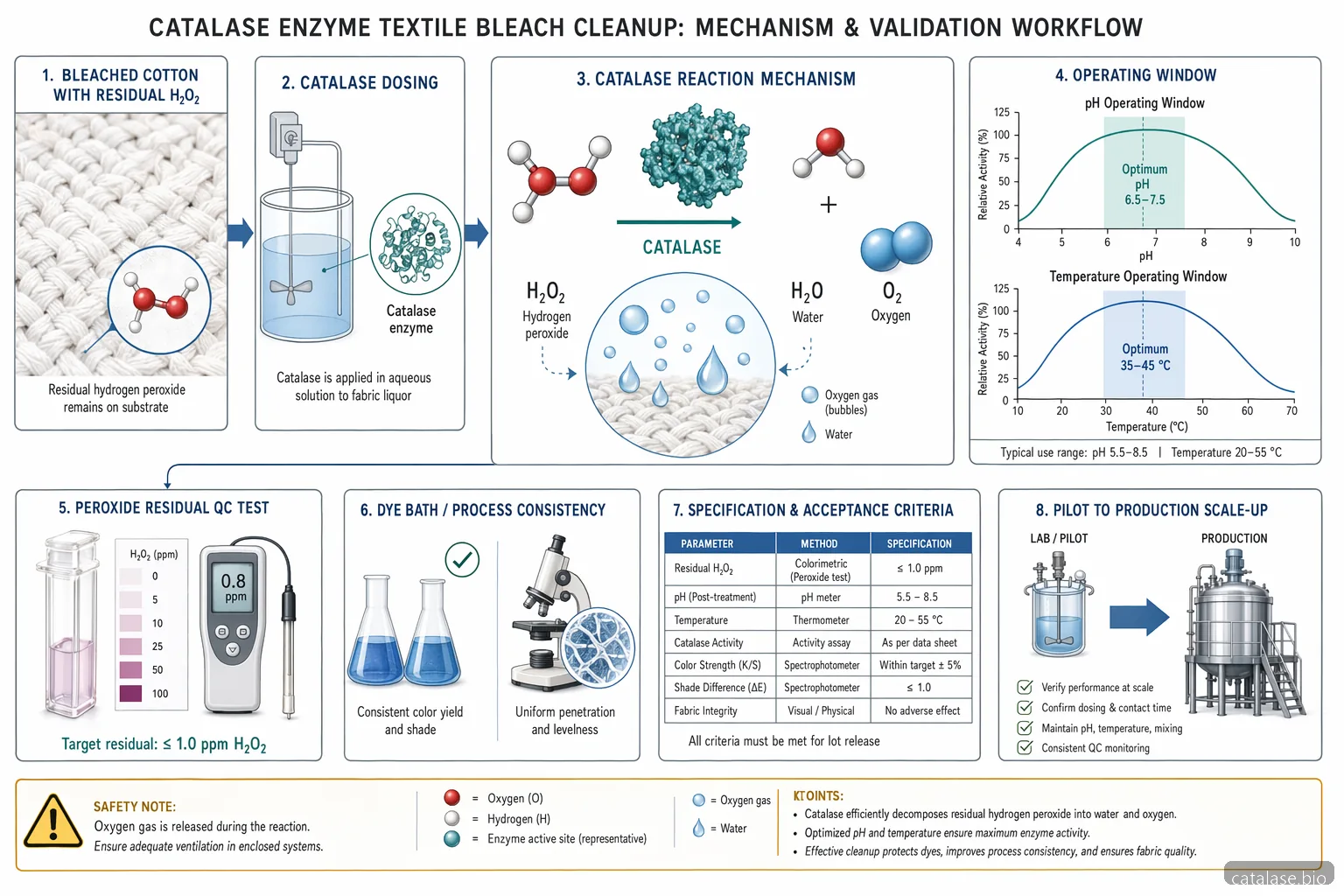
Practical Process Conditions for Textile Bleach Cleanup
Typical catalase textile trials are run after peroxide bleaching and sufficient rinsing or neutralization to bring the bath into the enzyme’s operating window. Many industrial catalase products perform well around pH 5.0–8.5, while some grades tolerate broader ranges; confirm the supplier’s TDS before production use. Common trial temperatures are approximately 30–60°C, with 40–55°C often used where fabric, equipment, and cycle time permit. Dosage can vary widely, but screening bands may start around 0.02–0.20% owg or approximately 0.1–1.0 g/L for liquid products, depending on enzyme activity, residual peroxide, liquor ratio, and contact time. Contact times of 10–20 minutes are often evaluated first. These are starting points, not universal instructions. Final conditions should be set by pilot validation, peroxide testing, shade results, and supplier technical review.
Confirm operating pH and temperature on the current TDS • Measure initial and final peroxide, not only time • Validate on the fabrics and dyes used in production
QC Checks That Protect Dyehouse Consistency
The best catalase enzyme program includes simple, repeatable QC checks. Before dosing, measure residual hydrogen peroxide using validated strips, titration, or an instrument method appropriate for your concentration range. After treatment, confirm the peroxide level is below the dyeing or finishing limit established by your process team. Some mills use a pass/fail peroxide strip at the machine, then periodic laboratory titration to verify accuracy. Track bath pH, temperature, contact time, liquor ratio, fabric weight, catalase lot number, and dosage. If oxygen foaming or rapid bubbling is observed, ensure the equipment can vent safely and that agitation remains consistent. For shade-critical work, run a control dyeing to confirm no peroxide carryover. QC records help separate enzyme performance issues from upstream bleaching variability, water quality, dosing error, or incorrect neutralization.
Check residual peroxide before and after catalase treatment • Record catalase batch number and dosage • Link QC results to shade and rework data
How to Compare Catalase Suppliers
A qualified supplier should provide a current COA for each batch, a technical data sheet with application guidance, and an SDS for safe handling and storage. Ask how activity is defined and tested, because activity units can differ between suppliers. Request recommended storage temperature, shelf life, packaging options, and data on stability after opening or dilution. For B2B purchasing, supplier qualification should also review lead time, lot traceability, change notification practices, technical support, and ability to support pilot work. Do not choose only by unit price. A higher-activity or more stable catalase may deliver lower cost-in-use if it reduces dosage, rework, rinsing, or cycle time. Ask for a sample with the same specification range as commercial supply, then document pilot results before approving a production purchase.
Request COA, TDS, SDS, and activity method • Review storage, shelf life, and lot traceability • Compare cost-in-use, not only purchase price
Pilot Validation Before Production Scale-Up
Pilot validation should reproduce the real bleach cleanup challenge as closely as possible. Use actual fabric, liquor ratio, water source, bleaching recipe, rinse sequence, and target dye class. Test at least two or three dosage points across the supplier’s recommended range, then measure residual peroxide at fixed contact times. Include a no-catalase control and, where useful, a current-product benchmark. Evaluate shade, levelness, hand feel, strength requirements, and any impact on downstream auxiliaries. For production scale-up, confirm dosing accuracy, mixing, bath turnover, and venting because the reaction releases oxygen. A successful trial should identify the minimum robust dose, acceptable pH and temperature window, QC method, and corrective action if peroxide remains above target. This documentation supports purchasing approval and repeatable plant operation.
Run a control, benchmark, and multiple catalase dosages • Confirm peroxide removal and dyeing performance • Approve a documented operating window before bulk buying
Technical Buying Checklist
Buyer Questions
Catalase enzyme is used to remove residual hydrogen peroxide after peroxide bleaching. It catalyzes the breakdown of hydrogen peroxide into water and oxygen before dyeing or finishing. This helps reduce peroxide carryover that can affect shade consistency, dye performance, and downstream chemicals. In a mill, the enzyme should be validated against the actual fabric, pH, temperature, peroxide level, and target dyeing process.
Yes, catalase is an enzyme. In industrial textile applications, the catalase enzyme substrate is hydrogen peroxide. The reaction converts hydrogen peroxide into water and oxygen, which is why catalase is useful after bleaching. When comparing products, buyers should check activity units, pH and temperature tolerance, formulation stability, and the supplier’s recommended dosage method for the peroxide level present.
Dosage depends on enzyme activity, residual peroxide concentration, liquor ratio, fabric load, pH, temperature, and contact time. For screening, some mills evaluate about 0.02–0.20% owg or 0.1–1.0 g/L for liquid products, then refine by peroxide testing. The approved production dose should be the lowest robust dose that consistently reaches the mill’s peroxide target without harming dyeing results.
Request a certificate of analysis for the batch, a technical data sheet, and a safety data sheet. Also ask for the activity test method, storage guidance, shelf life, packaging options, traceability, and change notification practice. For supplier qualification, it is reasonable to request a pilot sample, technical support, and written recommendations for your pH, temperature, peroxide level, and textile substrate.
Do not compare catalase only by price per kilogram or liter. Compare cost-in-use based on the dose needed to reach the peroxide target, cycle time, rinse water reduction, rework avoidance, shelf-life losses, and process reliability. A concentrated or more stable product may cost more upfront but perform better commercially if it reduces dosage, variability, or production delays.
Catalase for Research & Industry
Need Catalase for your lab or production process?
ISO 9001 certified · Food-grade & research-grade · Ships to 80+ countries
Frequently Asked Questions
What is catalase enzyme used for in textile bleach cleanup?
Catalase enzyme is used to remove residual hydrogen peroxide after peroxide bleaching. It catalyzes the breakdown of hydrogen peroxide into water and oxygen before dyeing or finishing. This helps reduce peroxide carryover that can affect shade consistency, dye performance, and downstream chemicals. In a mill, the enzyme should be validated against the actual fabric, pH, temperature, peroxide level, and target dyeing process.
Is catalase an enzyme, and what is the catalase enzyme substrate?
Yes, catalase is an enzyme. In industrial textile applications, the catalase enzyme substrate is hydrogen peroxide. The reaction converts hydrogen peroxide into water and oxygen, which is why catalase is useful after bleaching. When comparing products, buyers should check activity units, pH and temperature tolerance, formulation stability, and the supplier’s recommended dosage method for the peroxide level present.
How much catalase enzyme should a textile mill use?
Dosage depends on enzyme activity, residual peroxide concentration, liquor ratio, fabric load, pH, temperature, and contact time. For screening, some mills evaluate about 0.02–0.20% owg or 0.1–1.0 g/L for liquid products, then refine by peroxide testing. The approved production dose should be the lowest robust dose that consistently reaches the mill’s peroxide target without harming dyeing results.
What documents should I request from a catalase supplier?
Request a certificate of analysis for the batch, a technical data sheet, and a safety data sheet. Also ask for the activity test method, storage guidance, shelf life, packaging options, traceability, and change notification practice. For supplier qualification, it is reasonable to request a pilot sample, technical support, and written recommendations for your pH, temperature, peroxide level, and textile substrate.
How should catalase cost-in-use be compared?
Do not compare catalase only by price per kilogram or liter. Compare cost-in-use based on the dose needed to reach the peroxide target, cycle time, rinse water reduction, rework avoidance, shelf-life losses, and process reliability. A concentrated or more stable product may cost more upfront but perform better commercially if it reduces dosage, variability, or production delays.
Related: Catalase for Peroxide Removal at Working Temperatures
Turn This Guide Into a Supplier Brief Request a catalase enzyme sample, COA/TDS/SDS, and pilot support for your textile peroxide removal process. See our application page for Catalase for Peroxide Removal at Working Temperatures at /applications/activity-temperature-catalase/ for specs, MOQ, and a free 50 g sample.
Contact Us to Contribute