Application of Catalase Enzyme for Textile Bleach Cleanup
Guide to catalase enzyme for peroxide bleach cleanup: pH, temperature, dosing, QC checks, pilot validation, and supplier qualification.
Catalase helps mills remove residual hydrogen peroxide after bleaching, reducing rinse demand and preparing fabric for reliable dyeing or finishing.
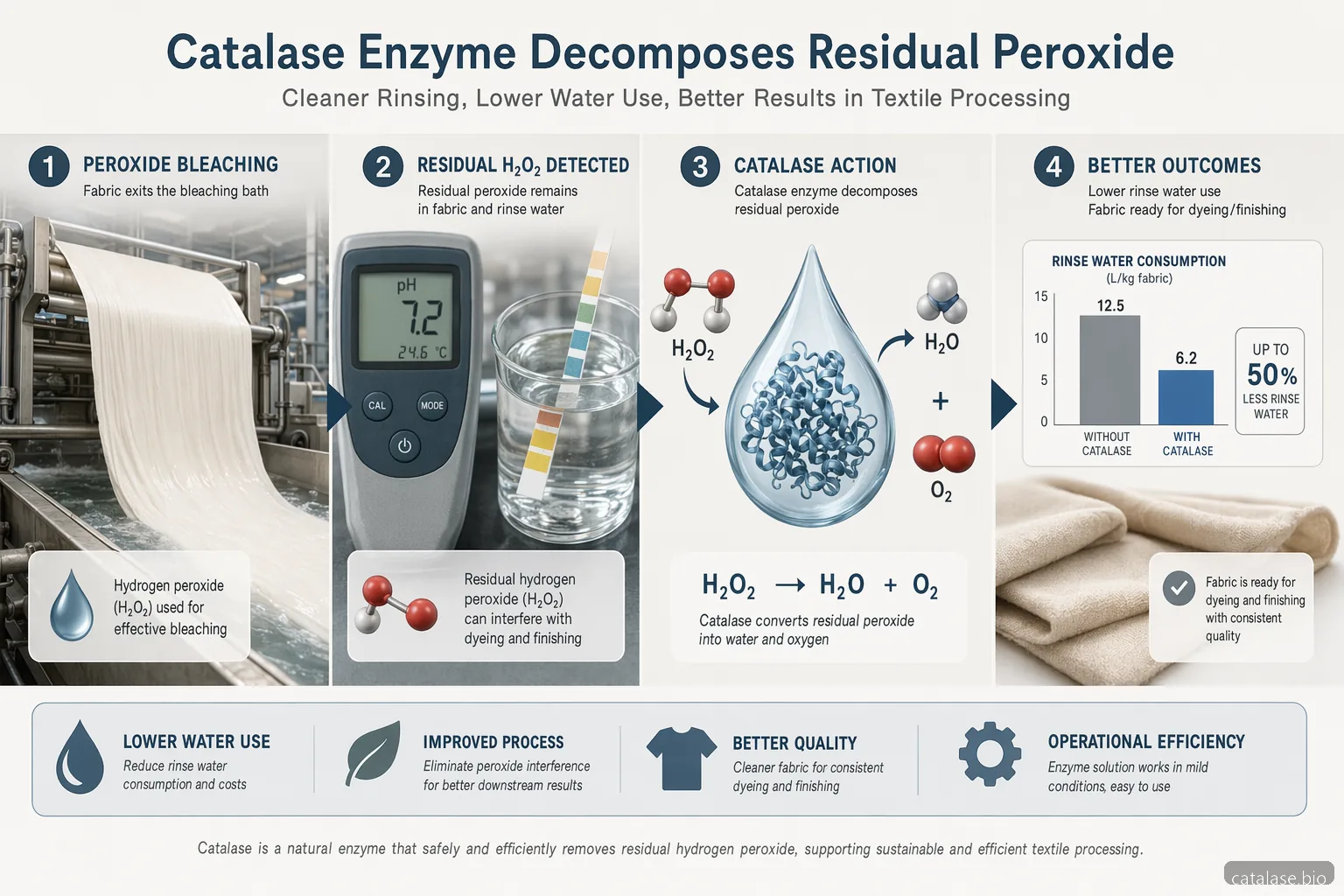
Why Catalase Is Used After Peroxide Bleaching
In peroxide bleaching, residual hydrogen peroxide can remain in cotton, cotton blends, yarn packages, or process liquor. If it is not removed before reactive dyeing or finishing, peroxide may interfere with dyes, auxiliaries, optical brighteners, and reducing agents. The application of catalase enzyme gives mills a targeted way to decompose this peroxide without relying only on repeated hot rinsing or chemical reducing agents. Catalase enzyme acts on one main substrate, hydrogen peroxide, converting it into water and oxygen. This makes the enzyme catalase useful where the goal is bleach cleanup rather than broad chemical reduction. For B2B buyers, the value is not just enzyme price per kilogram; it is the total effect on water use, process time, shade consistency, reprocessing, and effluent load. A good process guide should therefore start with peroxide level, liquor ratio, pH, temperature, fabric construction, and the next production step.
Primary use: hydrogen peroxide removal after bleaching • Common next steps: dyeing, printing, softening, or finishing • Main buying metric: verified cost-in-use, not drum price alone
Recommended Process Window for Textile Mills
Most textile catalase products are designed for moderate process conditions, commonly around pH 6.0-8.5 and 30-55°C, although exact limits must come from the supplier TDS. A practical starting point is to cool and adjust the bath after bleaching, add catalase under circulation, and hold for 10-20 minutes before testing residual peroxide. Dosage is usually expressed as grams or milliliters per kilogram of fabric, or as a percentage on weight of goods. Many mills begin screening in a broad band such as 0.05-0.30% owg, then optimize based on peroxide load, bath volume, contact time, and enzyme activity. Higher peroxide residues, high alkalinity, surfactant carryover, or insufficient mixing can require more enzyme or longer treatment. The process should be validated at pilot scale before bulk production, because package dyeing, open-width fabric, and garment processing have different mass-transfer profiles.
Typical pH screening range: 6.0-8.5 • Typical temperature screening range: 30-55°C • Typical contact time: 10-20 minutes, then QC test • Pilot before scale-up, especially with dense packages or heavy fabrics
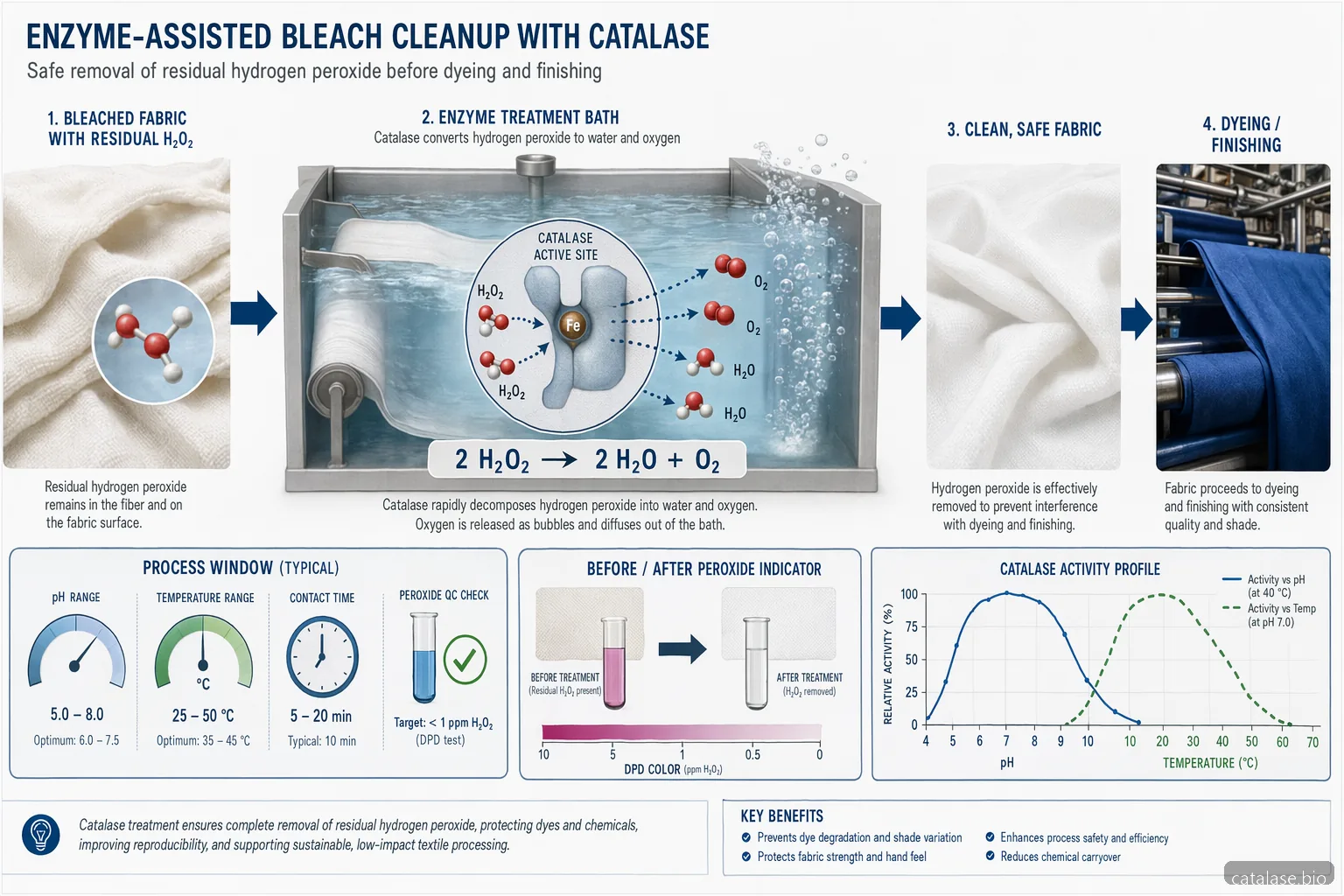
How Enzymes and Catalase Work in This Application
Buyers often ask, is catalase an enzyme, and what does the enzyme catalase do in a mill process? Catalase is a biological catalyst that accelerates the decomposition of hydrogen peroxide. In textile bleach cleanup, the catalase enzyme substrate is residual H2O2 left after alkaline peroxide bleaching. The reaction does not bleach fabric further; it removes the oxidant that could disturb downstream dye chemistry. This is different from amylase desizing, cellulase biopolishing, or laccase-based oxidative applications. Because enzymes and catalase products are activity-based materials, performance depends on storage, age, dilution practice, process pH, temperature, and inhibitors. Procurement teams should request activity units and test method information on the COA, then confirm performance in the plant’s own bath conditions. A stable product with a slightly higher unit price may be lower cost-in-use if it reduces overdosing, waiting time, or failed peroxide checks.
Reaction target: hydrogen peroxide • Reaction output: water and oxygen • Performance driver: active enzyme units under real mill conditions
Quality Control Checks Before Dyeing or Finishing
Effective peroxide removal must be verified, not assumed. Common QC checks include peroxide test strips, titration, or validated mill methods for residual H2O2 in bath liquor and, where relevant, fabric extract. The acceptable residual level depends on the next step and the sensitivity of the dyes or auxiliaries. For reactive dyeing, many mills target near-zero detectable peroxide before adding dye and alkali, but the actual specification should be set by the dyehouse based on shade risk and historical data. Operators should record initial peroxide, enzyme dosage, pH, temperature, contact time, final peroxide, and any observed foaming or odor. A simple hold-and-test protocol helps avoid under-treatment. If peroxide remains, the bath may need more time, additional catalase, improved circulation, or pH correction. If repeated failures occur, review bleach recipe carryover, enzyme storage, dilution water quality, and dosing pump accuracy.
Test before adding dyes or finishing auxiliaries • Record pH, temperature, time, dosage, and peroxide result • Investigate persistent residual peroxide instead of simply overdosing
Supplier Qualification and Documents to Request
Industrial enzyme purchasing should include technical and quality documentation. Ask for a current TDS with application guidance, pH and temperature ranges, storage recommendations, and handling notes. Request an SDS for worker safety, transport, spill response, and personal protective equipment planning. A COA should accompany each batch and include product identification, batch number, manufacture or release date, expiry or retest date, and activity or release specifications where applicable. Avoid basing qualification on unverifiable claims; instead, compare documented activity, consistency, shelf life, packaging, lead time, and technical support. For large textile operations, supplier qualification should also include sample evaluation, pilot validation, commercial trial review, and an agreed change-notification process. If your search includes catalase enzyme: application in bioremediation and food industry, remember that textile bleach cleanup has different purity, dosing, and performance criteria from dairy or food preservation applications.
Request COA, TDS, and SDS before approval • Confirm batch traceability and activity specification • Validate in your process instead of relying on generic claims • Review packaging, storage, lead time, and technical support
Cost-in-Use: What Textile Buyers Should Calculate
The lowest quoted price is not always the best purchasing decision. Cost-in-use for enzyme catalase should include dose required per kilogram of goods, peroxide load handled, treatment time, bath temperature, water and steam savings, reduced rinse steps, and avoided shade correction or reprocessing. A concentrated product may reduce freight, storage, and handling, but only if it remains stable and easy to dose accurately. Conversely, a lower-activity liquid may still be economical where peroxide residues are low and process time is flexible. Buyers should run side-by-side trials using the same fabric, bleach recipe, bath ratio, temperature, and QC method. Calculate total cost per batch and per kilogram of finished fabric, then compare process robustness. The preferred catalase enzyme should deliver consistent peroxide removal across normal plant variation, not only under ideal laboratory conditions.
Compare cost per kg of fabric processed • Include water, energy, time, and rework risk • Use identical trial conditions for supplier comparison • Select for robustness, not only minimum dose
Technical Buying Checklist
Buyer Questions
Catalase enzyme is an industrial biocatalyst used to decompose residual hydrogen peroxide after peroxide bleaching. In textile processing, it is mainly applied before dyeing, printing, or finishing so that leftover oxidant does not interfere with dyes and auxiliaries. The practical question is not only what is catalase enzyme, but whether the selected product works at your mill’s pH, temperature, liquor ratio, and peroxide load.
The enzyme catalase converts hydrogen peroxide into water and oxygen. Hydrogen peroxide is the catalase enzyme substrate in this application. The reaction helps remove residual oxidant after bleaching without adding a conventional reducing agent. Mills still need QC testing because incomplete peroxide removal can affect shade, reproducibility, and finishing performance, especially in peroxide-sensitive dye systems.
Catalase is an enzyme, not a general chemical reducing agent. It catalyzes a specific reaction with hydrogen peroxide, which is why it is useful for textile bleach cleanup. This specificity can support cleaner process control, but it also means catalase will not solve unrelated issues such as unfixed dye, metal contamination, poor scouring, or incorrect pH in the dye bath.
Start with the supplier’s TDS dosage guidance, then run trials across a controlled dosage band such as 0.05-0.30% owg or the recommended mL/kg range. Measure initial and final peroxide, pH, temperature, and treatment time. Optimize for the lowest robust dose that consistently passes QC under normal production variation, not just the minimum dose that works once in a lab beaker.
Request a COA, TDS, and SDS before purchasing. The COA should identify the batch and release specifications, the TDS should show application conditions and storage guidance, and the SDS should cover handling and safety. For supplier qualification, also review sample support, lead time, packaging, shelf life, change notification, and the ability to support pilot and commercial validation.
Catalase is used in several industries, including textile processing, dairy, and food preservation, but the product requirements are not identical. Textile bleach cleanup focuses on peroxide removal, process stability, and cost-in-use. Food or dairy applications may require different purity, regulatory, and handling expectations. Do not substitute across applications without reviewing the TDS, SDS, intended use, and supplier guidance.
Catalase for Research & Industry
Need Catalase for your lab or production process?
ISO 9001 certified · Food-grade & research-grade · Ships to 80+ countries
Frequently Asked Questions
What is catalase enzyme in textile processing?
Catalase enzyme is an industrial biocatalyst used to decompose residual hydrogen peroxide after peroxide bleaching. In textile processing, it is mainly applied before dyeing, printing, or finishing so that leftover oxidant does not interfere with dyes and auxiliaries. The practical question is not only what is catalase enzyme, but whether the selected product works at your mill’s pH, temperature, liquor ratio, and peroxide load.
What does the enzyme catalase do to hydrogen peroxide?
The enzyme catalase converts hydrogen peroxide into water and oxygen. Hydrogen peroxide is the catalase enzyme substrate in this application. The reaction helps remove residual oxidant after bleaching without adding a conventional reducing agent. Mills still need QC testing because incomplete peroxide removal can affect shade, reproducibility, and finishing performance, especially in peroxide-sensitive dye systems.
Is catalase an enzyme or a chemical reducing agent?
Catalase is an enzyme, not a general chemical reducing agent. It catalyzes a specific reaction with hydrogen peroxide, which is why it is useful for textile bleach cleanup. This specificity can support cleaner process control, but it also means catalase will not solve unrelated issues such as unfixed dye, metal contamination, poor scouring, or incorrect pH in the dye bath.
How should a mill choose the dosage of catalase enzyme?
Start with the supplier’s TDS dosage guidance, then run trials across a controlled dosage band such as 0.05-0.30% owg or the recommended mL/kg range. Measure initial and final peroxide, pH, temperature, and treatment time. Optimize for the lowest robust dose that consistently passes QC under normal production variation, not just the minimum dose that works once in a lab beaker.
What documents should be requested from a catalase supplier?
Request a COA, TDS, and SDS before purchasing. The COA should identify the batch and release specifications, the TDS should show application conditions and storage guidance, and the SDS should cover handling and safety. For supplier qualification, also review sample support, lead time, packaging, shelf life, change notification, and the ability to support pilot and commercial validation.
Can the same catalase be used for textile, dairy, and food preservation?
Catalase is used in several industries, including textile processing, dairy, and food preservation, but the product requirements are not identical. Textile bleach cleanup focuses on peroxide removal, process stability, and cost-in-use. Food or dairy applications may require different purity, regulatory, and handling expectations. Do not substitute across applications without reviewing the TDS, SDS, intended use, and supplier guidance.
Related: Catalase for Peroxide Removal at Working Temperatures
Turn This Guide Into a Supplier Brief Request a catalase sample, COA/TDS/SDS, and pilot protocol for your textile peroxide cleanup process. See our application page for Catalase for Peroxide Removal at Working Temperatures at /applications/activity-temperature-catalase/ for specs, MOQ, and a free 50 g sample.
Contact Us to Contribute