Catalase Enzyme: Application in Bioremediation and Food Industry
Troubleshoot catalase dosage, pH, temperature, and QC for hydrogen peroxide removal in food preservation and industrial processes.
A practical buyer’s guide to using catalase enzyme for controlled hydrogen peroxide removal in food preservation, dairy, textile, and wastewater applications.
What the Catalase Enzyme Does in Industrial Systems
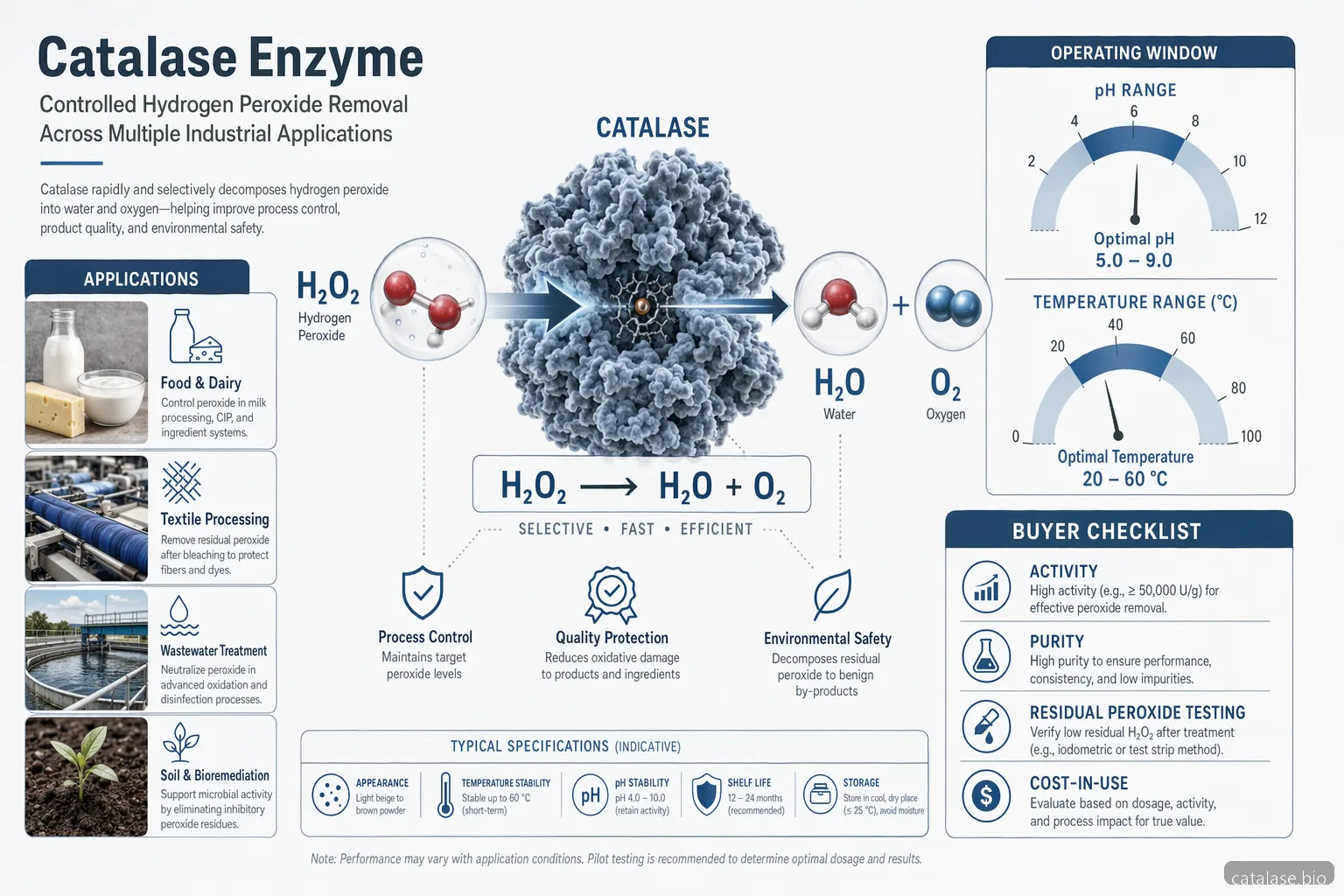
What does the enzyme catalase do? In industrial processing, the catalase enzyme decomposes hydrogen peroxide into water and oxygen. Hydrogen peroxide is the catalase enzyme substrate, and the reaction is valuable after peroxide has served its antimicrobial, bleaching, or oxidation function. For B2B buyers, the practical question is not only “is catalase an enzyme,” but whether a specific enzyme catalase product performs reliably in the actual plant matrix. Food liquids, dairy streams, brines, packaging rinse water, textile baths, and wastewater can contain salts, proteins, surfactants, metals, or cleaning residues that change performance. Among enzymes and catalase applications, peroxide removal is highly measurable, so pilot trials can be designed around residual peroxide, contact time, and activity loss. A suitable product should be selected by source, activity units, carrier system, permitted processing aid status in the target market, and documentation rather than by generic activity claims alone.
Primary reaction: 2 H2O2 → 2 H2O + O2 • Main control variable: residual hydrogen peroxide after treatment • Common purchasing basis: declared activity, form, stability, and cost-in-use
Food Preservation Use: Dosage, pH, and Temperature
Catalase enzyme in food is typically used when hydrogen peroxide has been applied for surface sanitation, ingredient treatment, dairy-related peroxide reduction, or process-water control and must be lowered before filling, fermentation, concentration, or final formulation. A practical starting window for many commercial catalase preparations is pH 5.0–8.0 and 20–55 °C, with exact optima depending on enzyme source and formulation. For early screening, buyers often test several activity-based additions rather than one fixed mass dose, such as low, medium, and high bands across 50–1,000 activity units per mL or per gram of treated matrix, adjusted to peroxide load. Contact times of 10–45 minutes are common in trials, provided mixing is sufficient and oxygen release is safely managed. Heat treatment, filtration, or validated downstream controls may be required if the process specification requires enzyme inactivation or removal. Always confirm suitability against local food regulations and the supplier’s TDS.
Trial pH: commonly 5.0–8.0 • Trial temperature: commonly 20–55 °C • Pilot endpoint: residual peroxide within internal specification • Validate oxygen release, foaming, and sensory impact
Troubleshooting Incomplete Hydrogen Peroxide Removal
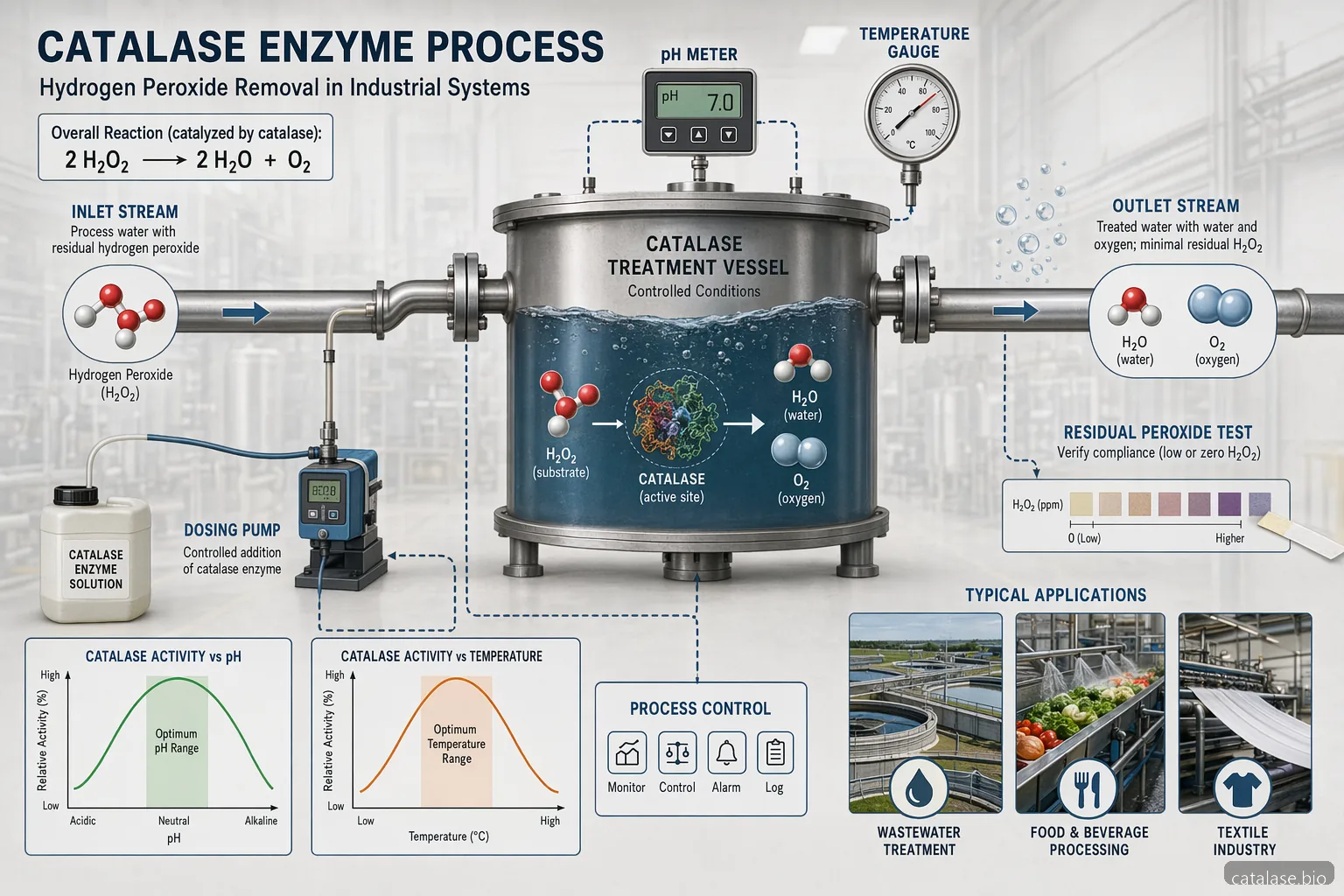
If residual peroxide remains above specification, first confirm the assay. Peroxide test strips can be useful for screening, but quantitative methods are better for release decisions. Then check whether the initial peroxide load was higher than assumed, because catalase dose demand increases with substrate concentration and exposure history. Poor mixing can create peroxide-rich zones that locally inactivate the enzyme catalase before the full batch is treated. pH outside the working range, high temperatures, oxidizing sanitizer carryover, heavy metals, and incompatible preservatives may also reduce activity. In viscous food systems, add catalase where turbulence is strongest and verify hold time at the coldest or least mixed point. If foaming occurs, evaluate slower dosing, larger headspace, lower agitation, or approved process antifoam options. Do not solve every issue by increasing dose; optimize sequence, dilution, residence time, and cleaning chemical rinse-out first.
Check initial and final peroxide with a validated method • Review pH and temperature at the point of enzyme addition • Avoid sanitizer carryover and localized high peroxide exposure • Confirm mixing in tanks, lines, and dead legs
Application in Bioremediation, Textile, and Wastewater
Catalase enzyme: application in bioremediation and food industry overlaps around the same technical goal: controlled hydrogen peroxide removal without adding harsh reducing agents. In textile bleach cleanup, catalase can reduce residual peroxide before dyeing, helping avoid shade variation caused by oxidant carryover. Typical screening conditions are near-neutral pH, about 6.0–8.5, and 30–55 °C, but the bath chemistry and surfactant package must be tested. In wastewater or bioremediation systems, catalase may be used to lower peroxide before biological treatment, protecting peroxide-sensitive microorganisms and reducing shock load risk. Dose should be calculated from measured peroxide concentration, flow, retention time, and activity loss in the wastewater matrix. Because effluents vary widely, jar tests or side-stream pilots are essential. Track residual peroxide, dissolved oxygen response, pH drift, COD/BOD impact, and compatibility with downstream aeration or biological treatment.
Textile focus: peroxide cleanup before dyeing or finishing • Wastewater focus: reduce peroxide before biological treatment • Pilot with actual effluent, not only clean water • Monitor peroxide, pH, dissolved oxygen, and downstream biology
Supplier Qualification and Cost-in-Use
For procurement teams, what is catalase enzyme quality in commercial terms? It is the combination of declared activity, stability, documentation, regulatory fit, technical support, and consistent cost-in-use. Request a current COA for each lot, a TDS with activity definition and recommended conditions, and an SDS for handling and storage. For food preservation, also request carrier composition, allergen statements where applicable, country-specific regulatory status, and guidance on whether the product is intended as a processing aid. Compare suppliers using pilot-validated dosage per metric ton or per 1,000 liters treated, not only unit price. A more concentrated product may reduce freight and storage but can be harder to dose accurately. A cheaper product may require higher addition rates or longer holding time. Build qualification around batch reproducibility, lead time, packaging integrity, cold-chain needs if any, and responsiveness during troubleshooting.
Request COA, TDS, SDS, and lot activity data • Compare total cost per treated volume or mass • Verify storage temperature and shelf-life claims • Run pilot validation before plant-wide conversion
Technical Buying Checklist
Buyer Questions
Yes. Catalase is an enzyme used industrially to decompose hydrogen peroxide into water and oxygen. In food processing, it may be used where peroxide has been applied for sanitation or treatment and must be reduced before the next step. Buyers should confirm the product’s intended food-use status, carrier ingredients, documentation, and local regulatory fit before commercial implementation.
There is no universal catalase enzyme dosage because demand depends on peroxide concentration, pH, temperature, contact time, matrix composition, and declared activity units. A practical approach is to run low, medium, and high activity-based trials on the real product or process water. Select the lowest dosage that consistently meets the residual peroxide specification with acceptable processing time and cost-in-use.
The enzyme catalase rapidly breaks down hydrogen peroxide, its substrate, into water and oxygen. This is useful when peroxide has completed its role and residual oxidant could affect flavor, color, fermentation, packaging, dyeing, or biological wastewater treatment. The reaction can release visible oxygen bubbles, so plant trials should account for foaming, headspace, pressure, and mixing conditions.
Many industrial catalase products work well near neutral pH, often around pH 5.0–8.0, and moderate temperatures such as 20–55 °C. However, optimal conditions vary by enzyme source and formulation. Use the supplier TDS as the starting point, then validate in the actual food matrix because salts, proteins, preservatives, and peroxide history can shift performance.
Compare suppliers by validated cost-in-use, not just price per kilogram or liter. Request COA, TDS, SDS, activity definition, shelf-life data, storage requirements, and batch-to-batch activity information. For food applications, ask for carrier composition and relevant food-use statements. A qualified supplier should support pilot testing, troubleshooting, dosage optimization, and scale-up from lab to production.
Yes, catalase can be used to reduce residual hydrogen peroxide before biological treatment or in peroxide-containing effluents. This may help protect peroxide-sensitive microorganisms and stabilize downstream treatment. Because wastewater composition changes, dosing should be based on measured peroxide, retention time, pH, temperature, and matrix inhibition. Jar tests and side-stream pilots are recommended before full-scale use.
Catalase for Research & Industry
Need Catalase for your lab or production process?
ISO 9001 certified · Food-grade & research-grade · Ships to 80+ countries
Frequently Asked Questions
Is catalase an enzyme used in food processing?
Yes. Catalase is an enzyme used industrially to decompose hydrogen peroxide into water and oxygen. In food processing, it may be used where peroxide has been applied for sanitation or treatment and must be reduced before the next step. Buyers should confirm the product’s intended food-use status, carrier ingredients, documentation, and local regulatory fit before commercial implementation.
What is catalase enzyme dosage for food preservation?
There is no universal catalase enzyme dosage because demand depends on peroxide concentration, pH, temperature, contact time, matrix composition, and declared activity units. A practical approach is to run low, medium, and high activity-based trials on the real product or process water. Select the lowest dosage that consistently meets the residual peroxide specification with acceptable processing time and cost-in-use.
What does the enzyme catalase do to hydrogen peroxide?
The enzyme catalase rapidly breaks down hydrogen peroxide, its substrate, into water and oxygen. This is useful when peroxide has completed its role and residual oxidant could affect flavor, color, fermentation, packaging, dyeing, or biological wastewater treatment. The reaction can release visible oxygen bubbles, so plant trials should account for foaming, headspace, pressure, and mixing conditions.
Which pH and temperature are best for catalase enzyme in food?
Many industrial catalase products work well near neutral pH, often around pH 5.0–8.0, and moderate temperatures such as 20–55 °C. However, optimal conditions vary by enzyme source and formulation. Use the supplier TDS as the starting point, then validate in the actual food matrix because salts, proteins, preservatives, and peroxide history can shift performance.
How should buyers compare enzymes and catalase suppliers?
Compare suppliers by validated cost-in-use, not just price per kilogram or liter. Request COA, TDS, SDS, activity definition, shelf-life data, storage requirements, and batch-to-batch activity information. For food applications, ask for carrier composition and relevant food-use statements. A qualified supplier should support pilot testing, troubleshooting, dosage optimization, and scale-up from lab to production.
Can catalase help in bioremediation or wastewater treatment?
Yes, catalase can be used to reduce residual hydrogen peroxide before biological treatment or in peroxide-containing effluents. This may help protect peroxide-sensitive microorganisms and stabilize downstream treatment. Because wastewater composition changes, dosing should be based on measured peroxide, retention time, pH, temperature, and matrix inhibition. Jar tests and side-stream pilots are recommended before full-scale use.
Related: Catalase for Egg Processing — Removing H2O2 from Dried, Liquid, and Pasteurized Egg Products
Turn This Guide Into a Supplier Brief Request a catalase enzyme TDS, COA, SDS, and pilot sample to validate dosage and cost-in-use in your process. See our application page for Catalase for Egg Processing — Removing H2O2 from Dried, Liquid, and Pasteurized Egg Products at /applications/catalase-egg-food-processing/ for specs, MOQ, and a free 50 g sample.
Contact Us to Contribute