Catalase Enzyme Production for Industrial Applications
Practical catalase enzyme production guide for industrial buyers: specs, dosing, QC, pilot validation, and supplier qualification.
A practical B2B guide to selecting, validating, and using catalase enzyme for peroxide removal in textile, dairy, and food processing operations.
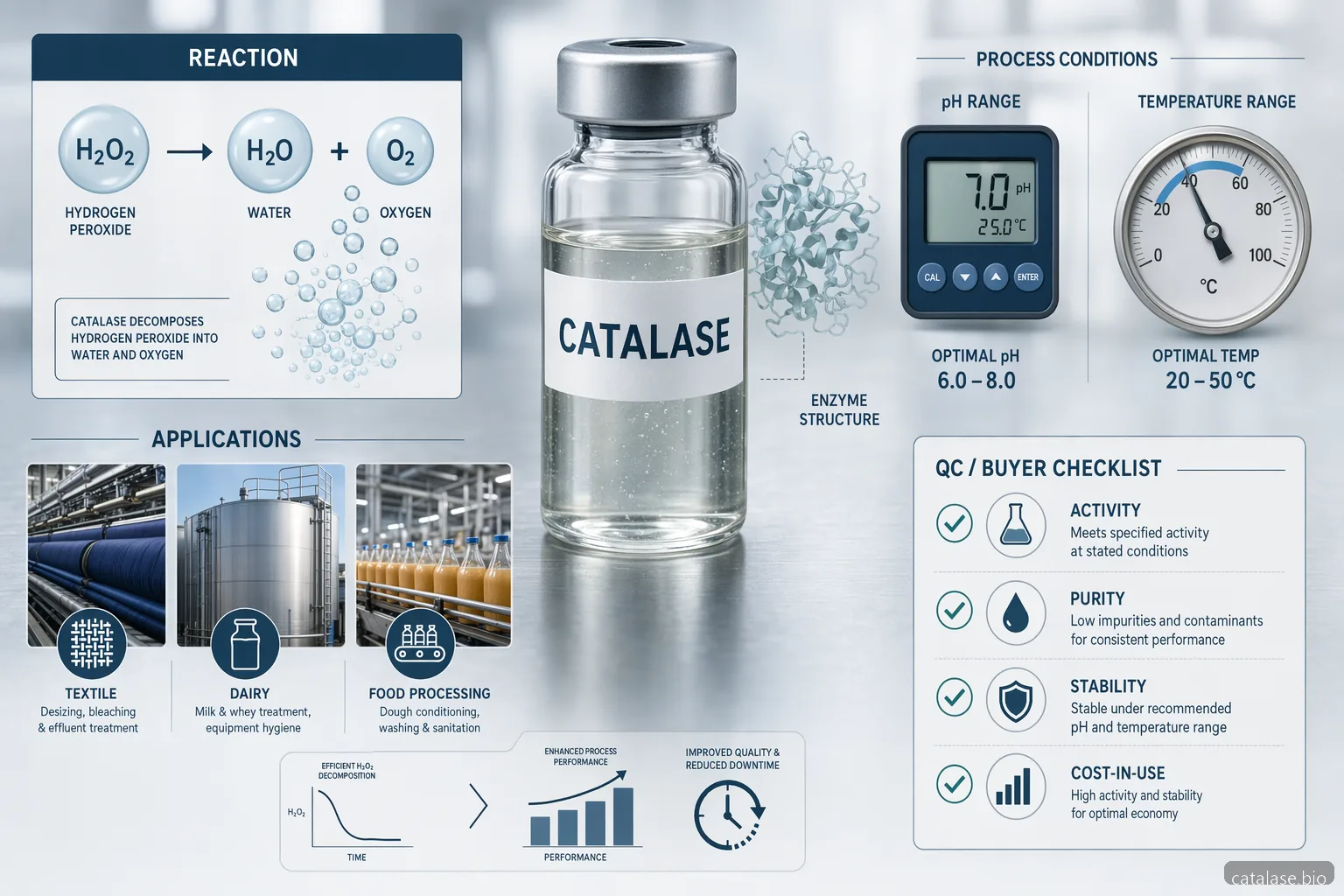
What Is Catalase Enzyme in Industrial Production?
Catalase is an enzyme used to decompose hydrogen peroxide into water and oxygen. For buyers asking “is catalase an enzyme” or “what is the catalase enzyme,” the practical answer is that catalase enzyme is a biocatalyst for peroxide removal, not a general-purpose oxidizer or preservative by itself. In production settings, the catalase enzyme substrate is hydrogen peroxide, commonly present after textile bleaching, equipment sanitation, milk treatment steps, or ingredient processing. The value of enzyme catalase is process control: it can reduce peroxide residues without high heat, excessive rinsing, or extended holding times. Because enzymes and catalase performance depend on conditions, the right grade must be selected against the actual process pH, temperature, peroxide concentration, salts, surfactants, and residence time. Industrial purchasing should focus on activity, formulation stability, regulatory suitability for the application, and documented technical support.
Primary reaction: 2 H2O2 → 2 H2O + O2 • Main function: hydrogen peroxide removal • Typical use areas: textile, dairy, food processing, and wash water treatment
Catalase Enzyme Production and Formulation Factors
Catalase enzyme production for industrial supply typically involves controlled microbial fermentation, downstream separation, concentration, stabilization, and formulation into liquid or dry products. Buyers do not need every manufacturing detail, but they should verify that the supplier controls activity, purity, bioburden, preservative system, and storage stability. Liquid catalase is often preferred for metered dosing into textile baths, dairy streams, or food-process water because it disperses quickly and is easy to automate. Dry catalase may be useful where transport efficiency, longer storage, or premix handling is important. Ask whether the stated activity is measured by a defined peroxide decomposition method and whether the unit definition is printed on the COA and TDS. A reliable supplier should explain expected activity retention during storage, recommended handling temperature, freeze-thaw sensitivity, and compatibility with common process aids.
Request batch-specific COA, current TDS, and SDS before approval. • Confirm activity unit definition and analytical method. • Check formulation type, preservatives, carrier, and storage range. • Review shelf-life data under recommended warehouse conditions.
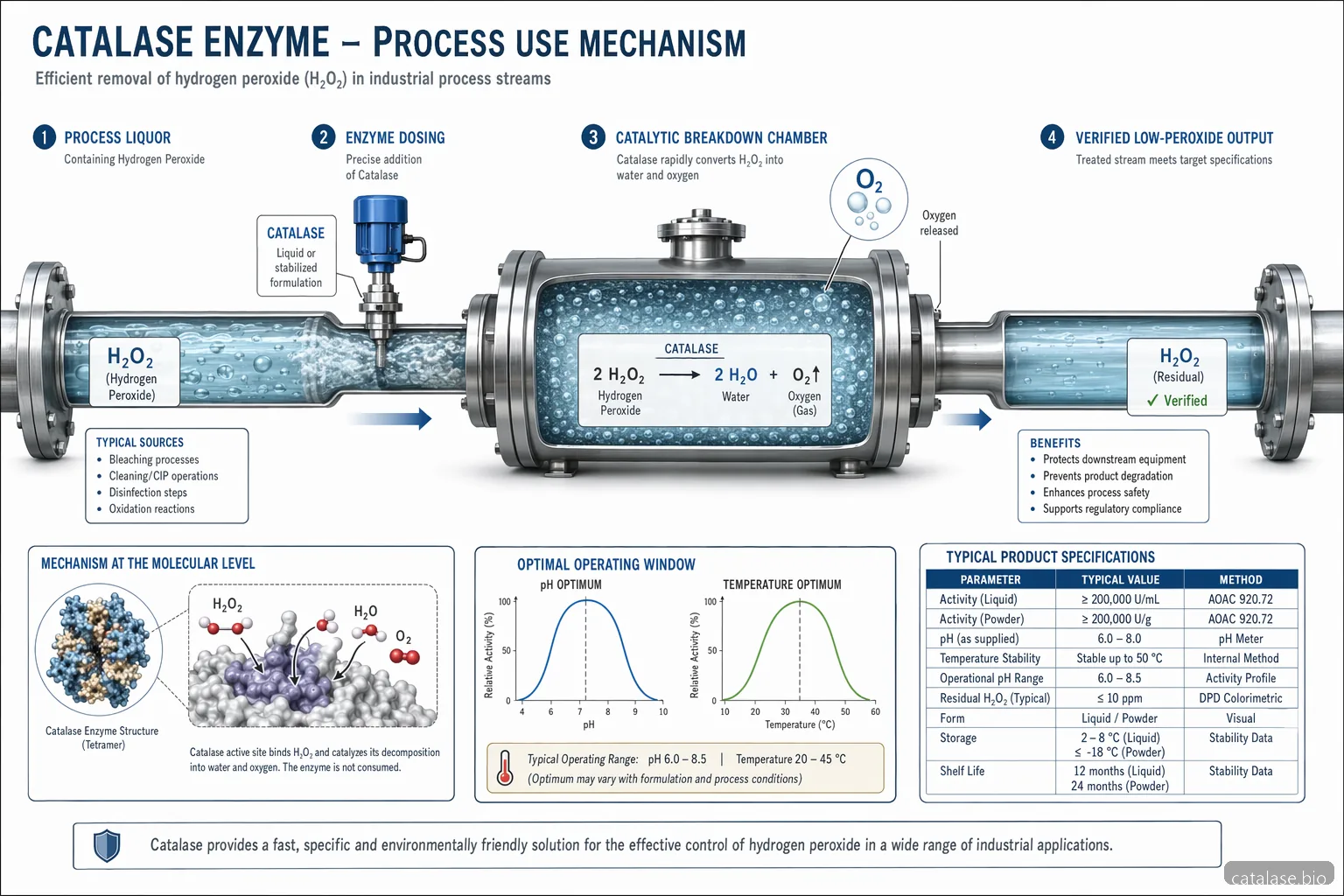
Process Conditions for Hydrogen Peroxide Removal
What does the enzyme catalase do under plant conditions? It accelerates peroxide breakdown, but its efficiency changes with pH, temperature, peroxide level, and inhibitors. Many commercial catalase enzyme products operate best near mild conditions, commonly around pH 5.0–9.0 and 25–55°C, although exact limits depend on strain, formulation, and intended industry. Textile bleach cleanup may occur after peroxide bleaching when the bath is cooled and pH is adjusted into the enzyme’s recommended range. Dairy and food preservation applications require additional attention to food-grade suitability, carryover, allergen statements where relevant, and local regulations. Dosage is usually established by residual peroxide testing, not by volume alone. As a starting point, plants may screen broad dosage bands such as 10–200 ppm product, then refine by peroxide load, contact time, and target residue level.
Control pH before dosing to avoid low activity or enzyme damage. • Avoid excessive heat unless the TDS confirms thermal tolerance. • Measure peroxide before and after treatment. • Allow venting or headspace management because oxygen is released.
Application Notes for Textile, Dairy, and Food Processing
In catalase textile applications, the enzyme is commonly used after peroxide bleaching to reduce residual hydrogen peroxide before dyeing. This can help prevent dye shade variation caused by oxidant carryover while reducing rinse burden. The process should be validated on actual fabric, liquor ratio, salts, surfactants, and dye chemistry. In dairy operations, catalase may be evaluated where controlled peroxide decomposition is required, subject to food-processing regulations and customer specifications. In food preservation workflows, catalase is often considered for removing residual peroxide from treated packaging, ingredient streams, or process water, depending on the permitted use and final product requirements. For all applications, pilot trials should define target peroxide level, dose curve, residence time, mixing intensity, and any effect on sensory, color, downstream fermentation, or packaging performance. Documented validation reduces scale-up surprises.
Textile: confirm dye compatibility after peroxide cleanup. • Dairy: verify food-grade status and regulatory fit. • Food processing: validate residue targets and downstream effects. • All uses: run pilot trials before plant-wide conversion.
Buyer Checklist: QC, Cost-in-Use, and Supplier Qualification
For catalase enzyme production sourcing, purchase price per kilogram is less important than cost-in-use. A concentrated, stable product with predictable activity may cost less per treated batch than a cheaper product requiring high dosage or frequent adjustment. Build comparisons around peroxide load, required final peroxide limit, contact time, dosing equipment, storage losses, and rejected-batch risk. Supplier qualification should include technical responsiveness, lot consistency, documentation quality, and ability to support pilot and scale-up work. Review the COA for activity, appearance, pH, microbial specifications when applicable, and lot number traceability. The TDS should state dosage guidance, operating pH and temperature, storage conditions, and incompatibilities. The SDS should support safe handling, spill response, and warehouse training. If the application touches food or dairy, request additional suitability statements instead of assuming one catalase enzyme grade fits every market.
Compare products by cost per unit peroxide removed. • Require consistent COA, TDS, and SDS documentation. • Audit supplier change-control communication. • Confirm technical support for pilot validation and troubleshooting.
Technical Buying Checklist
Buyer Questions
Catalase enzyme is used to remove residual hydrogen peroxide by converting it into water and oxygen. In B2B production, it is most often evaluated for textile bleach cleanup, dairy processing steps, food-process water, and treated packaging workflows. The exact use depends on regulatory suitability, peroxide load, pH, temperature, and the required final peroxide specification.
The enzyme catalase accelerates the breakdown of hydrogen peroxide, its substrate, into water and oxygen. This reaction can reduce oxidant carryover without relying only on heat, dilution, or repeated rinsing. Because oxygen gas is released, production teams should account for foaming, venting, headspace, and mixing during bench, pilot, and plant-scale trials.
Dose should be based on measured residual peroxide, bath pH, temperature, liquor ratio, fabric load, and desired treatment time. A practical trial may screen a broad dosage range, then narrow it using peroxide test strips or titration. Validate the final dose against dye shade, fabric quality, process time, and cost-in-use before routine production.
A qualified supplier should provide a batch-specific COA, current TDS, and SDS. The COA should identify activity, lot number, and relevant QC results. The TDS should include operating conditions, storage, dosage guidance, and incompatibilities. For dairy or food applications, request suitability statements and any applicable regulatory or compositional information.
Compare suppliers by verified activity, documentation quality, batch consistency, technical support, shelf-life stability, and cost per unit of peroxide removed. Run the same pilot protocol for each product using your real process water, fabric, milk stream, or food-contact matrix. Avoid selecting only by drum price because underperforming activity can increase dosage and risk.
Catalase for Research & Industry
Need Catalase for your lab or production process?
ISO 9001 certified · Food-grade & research-grade · Ships to 80+ countries
Frequently Asked Questions
What is catalase enzyme used for in production?
Catalase enzyme is used to remove residual hydrogen peroxide by converting it into water and oxygen. In B2B production, it is most often evaluated for textile bleach cleanup, dairy processing steps, food-process water, and treated packaging workflows. The exact use depends on regulatory suitability, peroxide load, pH, temperature, and the required final peroxide specification.
What does the enzyme catalase do to hydrogen peroxide?
The enzyme catalase accelerates the breakdown of hydrogen peroxide, its substrate, into water and oxygen. This reaction can reduce oxidant carryover without relying only on heat, dilution, or repeated rinsing. Because oxygen gas is released, production teams should account for foaming, venting, headspace, and mixing during bench, pilot, and plant-scale trials.
How should we dose catalase enzyme in textile processing?
Dose should be based on measured residual peroxide, bath pH, temperature, liquor ratio, fabric load, and desired treatment time. A practical trial may screen a broad dosage range, then narrow it using peroxide test strips or titration. Validate the final dose against dye shade, fabric quality, process time, and cost-in-use before routine production.
What documents should an industrial catalase supplier provide?
A qualified supplier should provide a batch-specific COA, current TDS, and SDS. The COA should identify activity, lot number, and relevant QC results. The TDS should include operating conditions, storage, dosage guidance, and incompatibilities. For dairy or food applications, request suitability statements and any applicable regulatory or compositional information.
How do we compare catalase enzyme suppliers?
Compare suppliers by verified activity, documentation quality, batch consistency, technical support, shelf-life stability, and cost per unit of peroxide removed. Run the same pilot protocol for each product using your real process water, fabric, milk stream, or food-contact matrix. Avoid selecting only by drum price because underperforming activity can increase dosage and risk.
Related: Catalase for Peroxide Removal at Working Temperatures
Turn This Guide Into a Supplier Brief Request catalase enzyme specifications, samples, and pilot support for your production process. See our application page for Catalase for Peroxide Removal at Working Temperatures at /applications/activity-temperature-catalase/ for specs, MOQ, and a free 50 g sample.
Contact Us to Contribute