Catalase Enzyme Formula: Supplier Guide for Textile Bleach Cleanup
B2B guide to catalase enzyme formula, textile peroxide removal, dosage trials, QC checks, COA/TDS/SDS review, and supplier qualification.
For textile mills, the practical catalase enzyme formula is the reaction that removes residual hydrogen peroxide before dyeing: fast, rinse-saving conversion to water and oxygen.
What the Catalase Enzyme Formula Means for Buyers
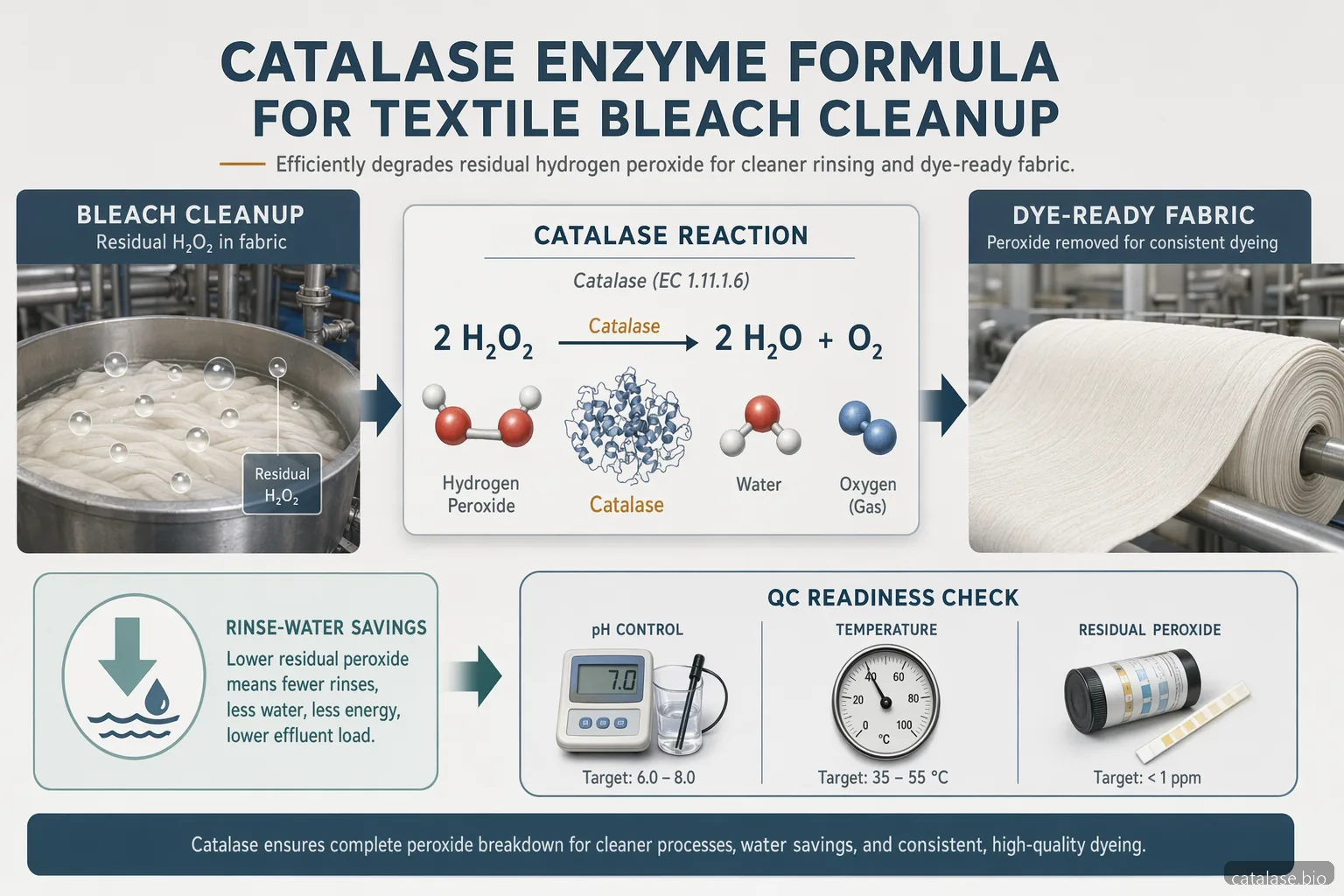
In industrial purchasing, catalase enzyme formula usually refers to the reaction formula rather than a single small-molecule chemical formula. Catalase is a protein enzyme, and its amino-acid sequence and molecular weight vary by production organism and grade. The useful process formula is: 2 H2O2 → 2 H2O + O2. In textile bleach cleanup, enzyme catalase decomposes residual hydrogen peroxide after scouring or bleaching so the dye bath is not harmed by oxidant carryover. This matters because peroxide can reduce dye yield, disturb reactive dye fixation, and create shade variation. If a supplier is asked, “is catalase an enzyme,” the answer is yes: catalase enzyme is a biocatalyst that acts on a specific substrate, hydrogen peroxide. For B2B evaluation, focus less on a generic formula and more on activity units, recommended pH, temperature tolerance, stabilizers, and compatibility with your mill process.
Reaction: 2 H2O2 → 2 H2O + O2 • Catalase enzyme substrate: hydrogen peroxide • Typical use: peroxide removal after bleaching and before dyeing
Textile Bleach Cleanup Process Conditions
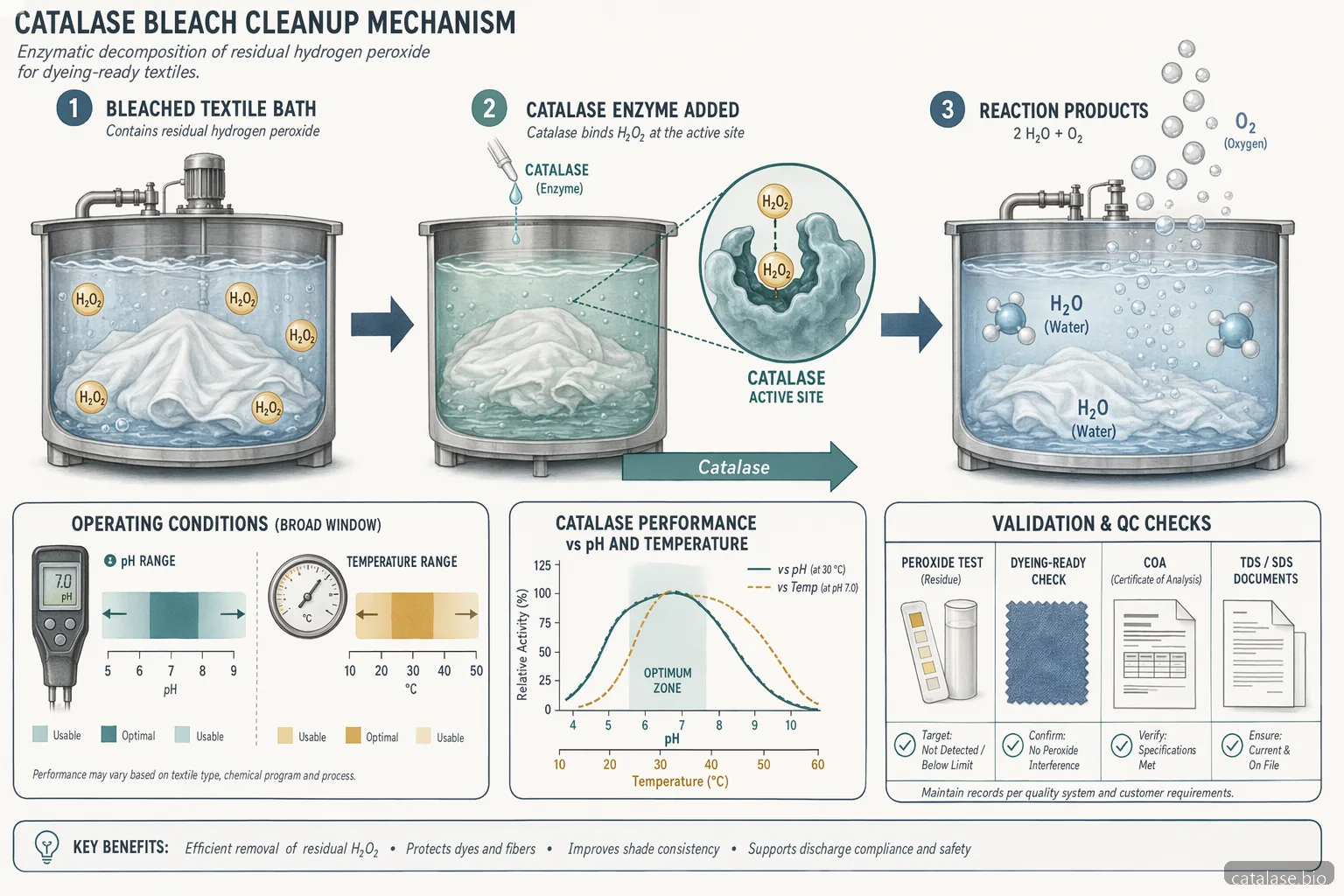
For textile bleach cleanup, catalase enzyme is normally added after alkaline peroxide bleaching once the bath is adjusted into the supplier’s working window. Many commercial products are evaluated around pH 5.0-9.0 and 20-60 °C, although optimum conditions depend on the enzyme source and formulation. Mills commonly run a short treatment of 10-20 minutes with sufficient circulation to contact fabric, yarn, or garment evenly. The enzyme should be added only after peroxide bleaching is complete and heavy alkali, high heat, or aggressive oxidant levels are reduced to the recommended range. Excessive temperature, extreme pH, or incompatible auxiliaries can lower activity. The best operating point is not always maximum activity; it is the lowest cost-in-use condition that reliably delivers peroxide residual low enough for the next dyeing step while fitting existing equipment, liquor ratio, scheduling, and discharge requirements.
Common trial pH: 5.0-9.0 • Common trial temperature: 20-60 °C • Typical contact time: 10-20 minutes • Confirm compatibility with surfactants, salts, and dyeing auxiliaries
Dosage Bands and Pilot Validation
A practical starting dosage for catalase textile applications is often in the range of 0.05-0.50 mL/L for liquid products, or 0.02-0.20 g/L for concentrated powders, but the correct level depends on declared activity, residual hydrogen peroxide, bath volume, fabric loading, time, and target residual. Do not buy only on price per kilogram or liter; compare performance at equivalent peroxide destruction. A pilot validation should include your real bleaching recipe, liquor ratio, fabric construction, temperature ramp, and downstream dye class. Sample the bath before and after treatment, and record residual peroxide, pH, temperature, treatment time, foam behavior, handle, whiteness, and dye shade. Scale-up should include one low-risk production lot before routine conversion. This approach answers what does the enzyme catalase do in your specific process: it reduces peroxide carryover in a measurable, controlled, and repeatable way.
Trial liquid dosage: 0.05-0.50 mL/L • Trial powder dosage: 0.02-0.20 g/L • Adjust dosage to enzyme activity and peroxide load • Validate on real fabric, not only laboratory water
QC Checks Before Dyeing
Quality control should verify that hydrogen peroxide removal is complete enough for the next step. Simple peroxide test strips are useful for quick floor checks, while permanganate or ceric sulfate titration can provide more quantitative control where required. Many mills target residual peroxide below 5-10 ppm before sensitive dyeing, but the correct specification should be set against dye class, shade depth, fabric, and customer requirements. Record lot number, dosage, pH, temperature, contact time, initial peroxide, final peroxide, and operator observations. Oxygen bubbles are expected during reaction, but visible bubbling alone is not proof of completion. If peroxide remains high, check enzyme age, storage temperature, bath pH, excessive temperature, residual alkali, and incompatible chemicals. QC data turns enzymes and catalase decisions from supplier promises into production evidence.
Use peroxide strips for fast checks • Use titration for tighter process control • Common target: below 5-10 ppm where dyeing is peroxide-sensitive • Document each lot and operating condition
COA, TDS, SDS, and Supplier Qualification
Before approving a catalase enzyme supplier, request a current technical data sheet, safety data sheet, certificate of analysis, recommended storage conditions, shelf-life statement, and activity test method. The COA should identify the lot, activity specification, appearance, and any key release parameters used by the manufacturer. The TDS should explain pH range, temperature range, dosage guidance, application method, and deactivation or downstream compatibility notes. The SDS should cover handling, dust or aerosol precautions, spill response, and transport classification. Supplier qualification should also review manufacturing consistency, change-control communication, traceability, packaging integrity, lead time, and technical support. Avoid relying on broad claims such as “high activity” without a defined assay. For industrial buyers asking what is the catalase enzyme best suited to their mill, the answer is the qualified product that performs consistently under verified plant conditions.
Request COA, TDS, and SDS before trial approval • Confirm activity assay and lot traceability • Review storage, shelf life, and packaging • Require change-control communication for formulation changes
Cost-in-Use for Textile Mills
Cost-in-use is the main commercial reason to evaluate catalase enzyme rather than extra hot rinsing or chemical reducing agents. A good comparison includes enzyme dosage, bath time, water use, energy use, neutralization needs, effluent impact, dye yield, rework risk, and production throughput. Catalase may support shorter processing by removing peroxide in the same bath or with fewer rinses, but savings must be proven on the mill’s own equipment. Include all costs: enzyme consumption, testing, operator handling, storage, inventory, and any process adjustment. Also compare the cost of failures, because incomplete peroxide removal can create off-shade lots and customer claims. The strongest business case combines technical validation with purchasing controls: approved specification, agreed documentation, stable supply, and measurable performance per kilogram of fabric.
Compare cost per treated kilogram of fabric • Include water, energy, time, and rework risk • Base approval on pilot and production data • Use performance metrics, not only unit price
Technical Buying Checklist
Buyer Questions
Catalase enzyme is a protein biocatalyst used to decompose hydrogen peroxide after textile bleaching. In mills, it helps remove residual oxidant before dyeing, reducing the risk of shade variation and dye damage. The practical catalase enzyme formula is the reaction 2 H2O2 → 2 H2O + O2. Product selection should be based on activity, process fit, documentation, and pilot results.
Is catalase an enzyme? Yes. Catalase is an enzyme, not a conventional reducing chemical such as bisulfite. It catalyzes the breakdown of hydrogen peroxide into water and oxygen and is not consumed in the same stoichiometric way as a reducing agent. For purchasing, compare the enzyme catalase by activity units, process tolerance, residual peroxide removal, and cost-in-use.
What does the enzyme catalase do after bleaching? It targets the catalase enzyme substrate, hydrogen peroxide, and rapidly decomposes it so the next dyeing stage is less exposed to oxidant carryover. This can reduce rinsing demand and support more consistent shades when validated correctly. Operators should still confirm completion using peroxide strips or titration before adding peroxide-sensitive dyes.
Choose a supplier by combining documentation review with process validation. Request COA, TDS, SDS, activity assay, shelf-life guidance, storage requirements, and lot traceability. Then run lab and pilot trials on actual fabric and bleaching recipes. The best supplier is not simply the lowest price; it is the source that delivers stable peroxide removal, technical support, reliable lead times, and clear change-control communication.
Acceptable residual peroxide depends on dye class, shade depth, substrate, and customer tolerance. Many textile operations target below 5-10 ppm before peroxide-sensitive dyeing, but each mill should set its own specification through testing. Verify residual peroxide after catalase treatment using strips for routine checks or titration for tighter control, and connect the result to shade reproducibility and rework rates.
Catalase for Research & Industry
Need Catalase for your lab or production process?
ISO 9001 certified · Food-grade & research-grade · Ships to 80+ countries
Frequently Asked Questions
What is catalase enzyme in textile processing?
Catalase enzyme is a protein biocatalyst used to decompose hydrogen peroxide after textile bleaching. In mills, it helps remove residual oxidant before dyeing, reducing the risk of shade variation and dye damage. The practical catalase enzyme formula is the reaction 2 H2O2 → 2 H2O + O2. Product selection should be based on activity, process fit, documentation, and pilot results.
Is catalase an enzyme or a chemical reducing agent?
Is catalase an enzyme? Yes. Catalase is an enzyme, not a conventional reducing chemical such as bisulfite. It catalyzes the breakdown of hydrogen peroxide into water and oxygen and is not consumed in the same stoichiometric way as a reducing agent. For purchasing, compare the enzyme catalase by activity units, process tolerance, residual peroxide removal, and cost-in-use.
What does the enzyme catalase do after bleaching?
What does the enzyme catalase do after bleaching? It targets the catalase enzyme substrate, hydrogen peroxide, and rapidly decomposes it so the next dyeing stage is less exposed to oxidant carryover. This can reduce rinsing demand and support more consistent shades when validated correctly. Operators should still confirm completion using peroxide strips or titration before adding peroxide-sensitive dyes.
How should a mill choose a catalase enzyme supplier?
Choose a supplier by combining documentation review with process validation. Request COA, TDS, SDS, activity assay, shelf-life guidance, storage requirements, and lot traceability. Then run lab and pilot trials on actual fabric and bleaching recipes. The best supplier is not simply the lowest price; it is the source that delivers stable peroxide removal, technical support, reliable lead times, and clear change-control communication.
What residual peroxide level is acceptable before dyeing?
Acceptable residual peroxide depends on dye class, shade depth, substrate, and customer tolerance. Many textile operations target below 5-10 ppm before peroxide-sensitive dyeing, but each mill should set its own specification through testing. Verify residual peroxide after catalase treatment using strips for routine checks or titration for tighter control, and connect the result to shade reproducibility and rework rates.
Related: Catalase for Peroxide Removal at Working Temperatures
Turn This Guide Into a Supplier Brief Request a catalase enzyme TDS, COA, SDS, and pilot-trial recommendation for your textile bleach cleanup process. See our application page for Catalase for Peroxide Removal at Working Temperatures at /applications/activity-temperature-catalase/ for specs, MOQ, and a free 50 g sample.
Contact Us to Contribute