Textile Catalase Enzyme Industry Report: How to Use Catalase in Textile Bleach Cleanup Formulations
Formulation guide for catalase enzyme in textile bleach cleanup: dosing, pH, temperature, QC, COA/TDS/SDS review, validation, and cost-in-use.
A practical B2B guide for selecting, dosing, validating, and buying catalase enzyme for hydrogen peroxide removal after textile bleaching.
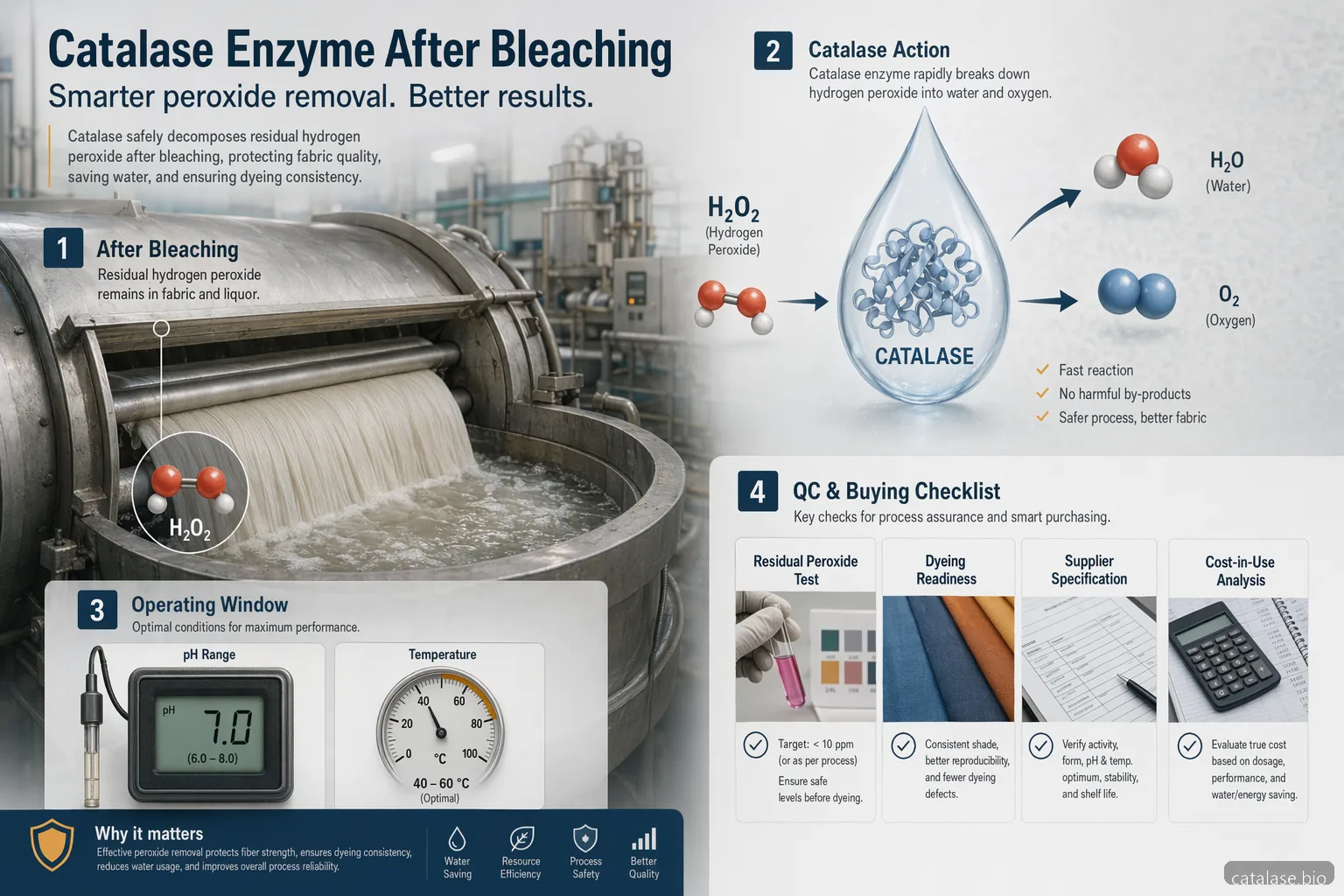
Market Need: Faster Peroxide Cleanup in Textile Wet Processing
This textile catalase enzyme industry report is written for mills, chemical formulators, and procurement teams evaluating catalase for peroxide bleach cleanup. In textile wet processing, the catalase enzyme substrate is residual hydrogen peroxide left after cotton or cellulosic bleaching. The enzyme catalase decomposes peroxide into water and oxygen, helping prepare the bath for reactive dyeing without long hot rinses or reducing agents. Because enzymes and catalase products differ by source, activity unit, stabilizer package, and liquid or powder format, selection should be based on process fit rather than label claims. The buyer question is not only what is catalase enzyme, but how it performs at mill pH, temperature, liquor ratio, fabric load, and peroxide carryover. A practical formulation program starts with TDS screening, COA confirmation, SDS review, bench dosage curves, then pilot validation on real goods.
Primary use: hydrogen peroxide removal after bleaching • Main substrate: residual H2O2 in the process bath • Primary buyer concern: reproducible dyeing readiness
Operating Window for Catalase Enzyme Formulations
Most textile catalase enzyme industry applications target mild conditions after the bleach stage has been drained, cooled, or adjusted. A common screening window is pH 5.5 to 8.5 and 25 to 60 °C, but the approved range must come from the supplier TDS and your own validation. Dosage is activity-dependent; many mills begin laboratory trials around 0.05% to 0.30% on weight of goods, or an equivalent liquid dose per liter of bath, then adjust to residual peroxide level and contact time. Ten to twenty minutes is a typical starting contact range when mixing is good. High alkalinity, oxidizer shock, heavy metals, incompatible biocides, or extreme temperature may reduce enzyme catalase performance. Formulators should test the exact surfactant, sequestrant, buffer, antifoam, and dye-house water system intended for production.
Screen pH: approximately 5.5-8.5 • Screen temperature: approximately 25-60 °C • Initial dosage band: supplier-activity dependent • Contact time: often 10-20 minutes in trials
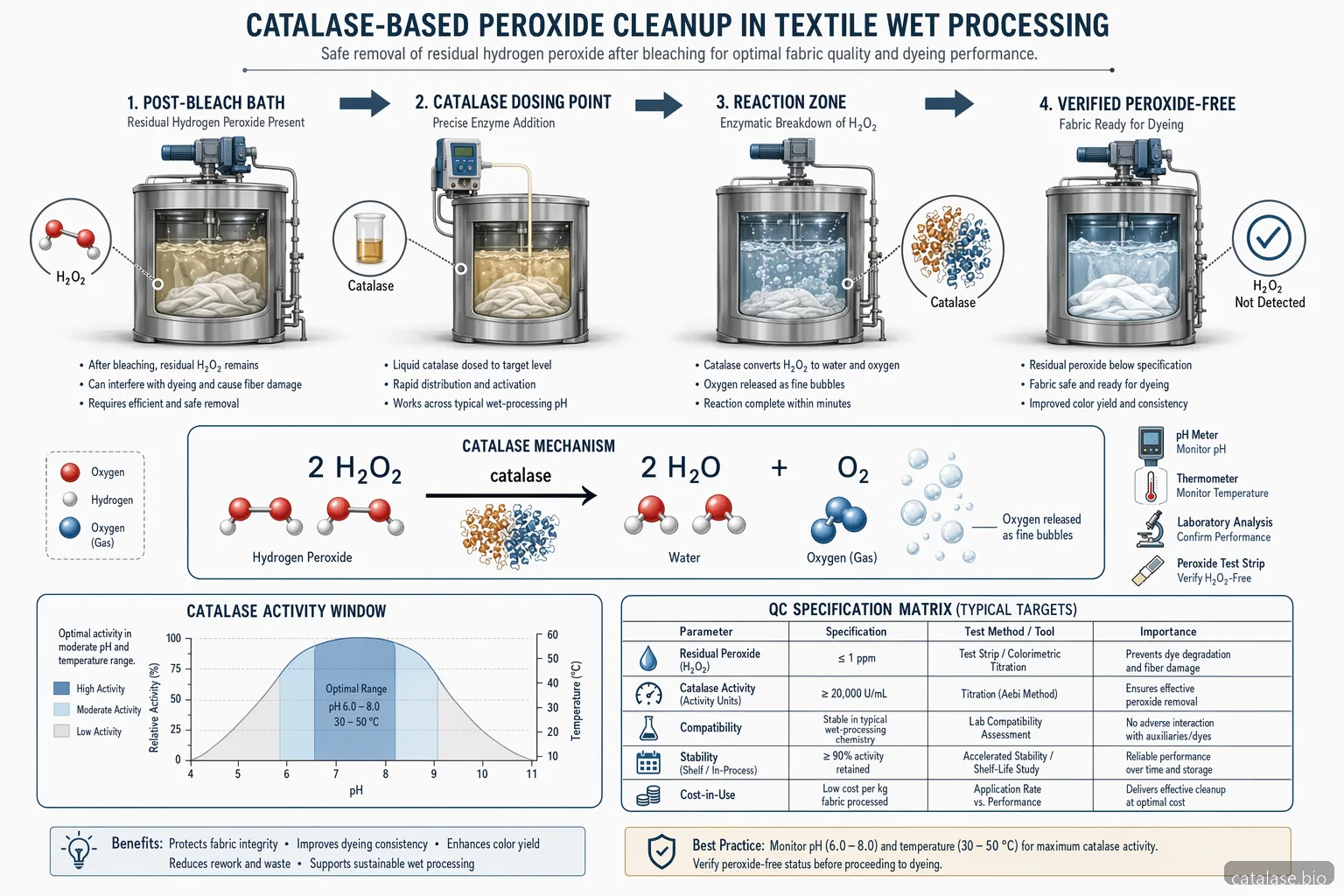
Formulation Strategy: Activity, Stability, and Compatibility
A catalase enzyme formulation should be designed around delivered activity in the bath, not only percent inclusion in the drum. Liquid catalase may be easier to pump and meter, while powder formats may support some dry blends where dust control and humidity protection are addressed. Stabilization systems can include buffers, polyols, salts, preservatives, and dispersing aids, but every additive should be checked against fabric hand, dye uptake, wastewater limits, and storage stability. For industrial buyers comparing enzymes and catalase options, request the activity method, unit definition, recommended storage temperature, shelf-life basis, and acceptable activity loss over time. Compatibility testing should include hard water, residual alkali, peroxide carryover, optical brighteners, wetting agents, and downstream dyes. A good formulation maintains enzyme activity during storage but releases effective catalase enzyme activity quickly in the cleanup bath.
Compare activity units, not only price per kilogram • Test liquid and powder handling under plant conditions • Confirm compatibility with auxiliaries and dyes
Quality Control Checks Before Dyeing
The most important QC question is whether residual hydrogen peroxide has reached the mill’s safe threshold for the next dyeing step. Practical checks include peroxide test strips for rapid line decisions and iodometric or permanganate titration for more quantitative laboratory confirmation. Establish a starting peroxide level, dose catalase enzyme, mix for the validated contact time, then recheck before adding dyes or sensitive auxiliaries. If residual peroxide remains high, investigate pH, bath temperature, peroxide load, enzyme age, dosage accuracy, mixing, or chemical incompatibility before increasing dose. Some mills also track shade deviation, first-time-right dyeing rate, water consumption, cycle time, and rework. QC should be written into a standard operating procedure so operators know when the bath is ready, when to hold, and when to escalate to the lab.
Use test strips for quick production checks • Use titration for quantitative validation • Track shade, rework, cycle time, and water use
Supplier Qualification and Cost-in-Use
Industrial buyers should qualify a catalase supplier with both documentation and plant evidence. Request a current COA for each lot, a technical data sheet with activity, operating range, storage, and dosing guidance, and an SDS covering safe handling, exposure controls, and spill response. Also evaluate batch traceability, packaging integrity, cold-chain or ambient logistics requirements, lead time, minimum order quantity, and technical support for troubleshooting. Cost-in-use should be calculated per kilogram of fabric or per batch, not only per kilogram of enzyme. Include dose required to reach the peroxide specification, water and steam savings, reduced neutralization chemistry, shorter cycle time, fewer dyeing defects, and any change in wastewater profile. A pilot run should precede full conversion, using production fabric, real process water, normal operators, and defined pass/fail criteria.
Request COA, TDS, and SDS before approval • Run pilot validation before full-scale adoption • Evaluate delivered cost and performance cost-in-use
Technical Buying Checklist
Buyer Questions
Yes. Catalase is an enzyme used in textile wet processing to remove residual hydrogen peroxide after bleaching. The enzyme catalase converts hydrogen peroxide into water and oxygen, helping prepare fabric for dyeing. For B2B use, the key is not the generic definition alone, but whether the specific catalase enzyme product performs under the mill’s pH, temperature, liquor ratio, and auxiliary chemistry.
Dosage depends on enzyme activity, residual peroxide level, bath volume, fabric load, pH, temperature, and contact time. A practical laboratory starting band is often about 0.05% to 0.30% on weight of goods, or an equivalent liquid bath dose. The final production dose should be set only after peroxide testing, shade validation, and supplier TDS review.
Use a defined QC method before dye addition. Peroxide test strips are useful for rapid production checks, while iodometric or permanganate titration can provide more quantitative lab confirmation. Record starting peroxide, catalase dose, pH, temperature, contact time, and final peroxide result. If the result is out of specification, troubleshoot mixing, enzyme age, pH, temperature, and chemical compatibility.
Request a COA for the supplied lot, a TDS with activity units and operating recommendations, and an SDS for safe handling and storage. Buyers should also ask for the activity test method, shelf-life basis, storage temperature, packaging details, traceability, lead time, and technical support availability. These documents support supplier qualification but do not replace pilot validation.
Cost-in-use should be calculated per batch or per kilogram of fabric, not only by enzyme price. Include the validated dosage, bath volume, peroxide removal time, water and steam reduction, neutralization chemical changes, rework reduction, and first-time-right dyeing performance. A higher-priced catalase enzyme may be economical if it lowers total processing cost and improves shade consistency.
Catalase for Research & Industry
Need Catalase for your lab or production process?
ISO 9001 certified · Food-grade & research-grade · Ships to 80+ countries
Frequently Asked Questions
Is catalase an enzyme used in textile processing?
Yes. Catalase is an enzyme used in textile wet processing to remove residual hydrogen peroxide after bleaching. The enzyme catalase converts hydrogen peroxide into water and oxygen, helping prepare fabric for dyeing. For B2B use, the key is not the generic definition alone, but whether the specific catalase enzyme product performs under the mill’s pH, temperature, liquor ratio, and auxiliary chemistry.
What is catalase enzyme dosage for textile bleach cleanup?
Dosage depends on enzyme activity, residual peroxide level, bath volume, fabric load, pH, temperature, and contact time. A practical laboratory starting band is often about 0.05% to 0.30% on weight of goods, or an equivalent liquid bath dose. The final production dose should be set only after peroxide testing, shade validation, and supplier TDS review.
How should a mill confirm hydrogen peroxide removal?
Use a defined QC method before dye addition. Peroxide test strips are useful for rapid production checks, while iodometric or permanganate titration can provide more quantitative lab confirmation. Record starting peroxide, catalase dose, pH, temperature, contact time, and final peroxide result. If the result is out of specification, troubleshoot mixing, enzyme age, pH, temperature, and chemical compatibility.
What documents should buyers request from a catalase supplier?
Request a COA for the supplied lot, a TDS with activity units and operating recommendations, and an SDS for safe handling and storage. Buyers should also ask for the activity test method, shelf-life basis, storage temperature, packaging details, traceability, lead time, and technical support availability. These documents support supplier qualification but do not replace pilot validation.
How is cost-in-use calculated for textile catalase enzyme?
Cost-in-use should be calculated per batch or per kilogram of fabric, not only by enzyme price. Include the validated dosage, bath volume, peroxide removal time, water and steam reduction, neutralization chemical changes, rework reduction, and first-time-right dyeing performance. A higher-priced catalase enzyme may be economical if it lowers total processing cost and improves shade consistency.
Related: Catalase for Textile Bleach Cleanup — Hydrogen Peroxide Removal Before Reactive Dyeing
Turn This Guide Into a Supplier Brief Request a catalase enzyme formulation review, documentation checklist, and pilot-trial plan for your textile bleach cleanup process. See our application page for Catalase for Textile Bleach Cleanup — Hydrogen Peroxide Removal Before Reactive Dyeing at /applications/catalase-textile-bleach-cleanup/ for specs, MOQ, and a free 50 g sample.
Contact Us to Contribute