How to Use Enzymes Catalase in Textile Bleach Cleanup Formulations
Formulate catalase enzyme bleach cleanup for textiles with pH, temperature, dosage, QC, COA/TDS/SDS, pilot trials, and cost-in-use guidance.
Catalase enzyme converts residual hydrogen peroxide into water and oxygen, helping textile mills move from peroxide bleaching to dyeing with fewer rinses and better process control.
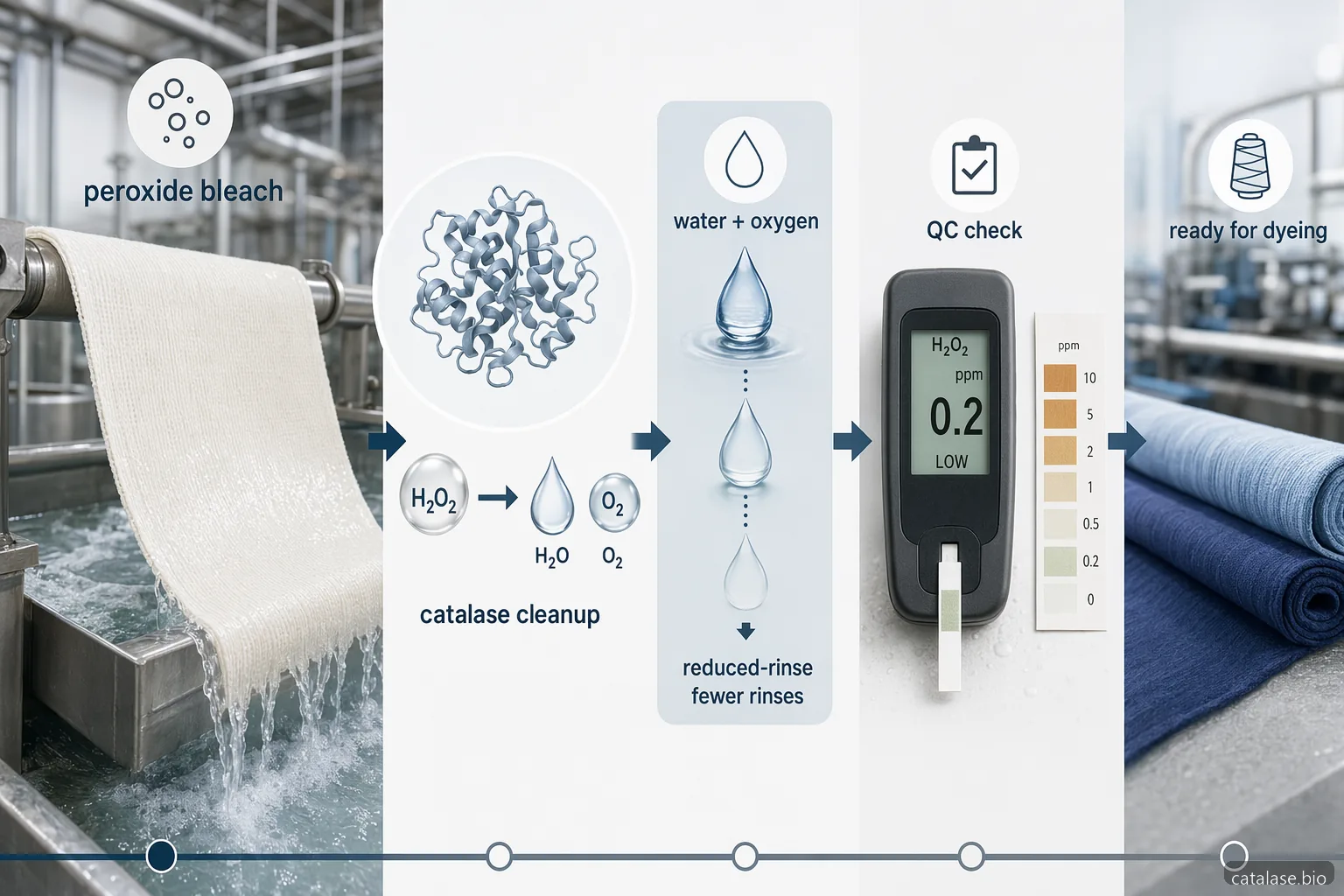
Why catalase is used after peroxide bleaching
In textile bleach cleanup, catalase enzymes are used to decompose residual hydrogen peroxide left after cotton or blended-fabric peroxide bleaching. The reaction is simple: hydrogen peroxide is converted into water and oxygen, reducing the risk that peroxide will interfere with reactive dyes, optical brighteners, softeners, or downstream finishing chemistry. For B2B formulators, the value is not just chemical removal; it is process simplification. A properly selected catalase enzyme can reduce extra rinsing, shorten cycle time, lower water load, and avoid reducing-agent residues that may affect shade reproducibility. When buyers ask, “is catalase an enzyme,” the answer is yes: enzyme catalase is a biocatalyst, and industrial catalase products are supplied as liquid or granular preparations with defined activity, handling guidance, and storage limits. The best product choice depends on fabric type, residual peroxide, pH, temperature, and mill workflow.
Primary target: residual hydrogen peroxide removal • Common position: after peroxide bleaching and before dyeing • Key outcome: lower peroxide carryover into dye bath
Recommended process window for formulation
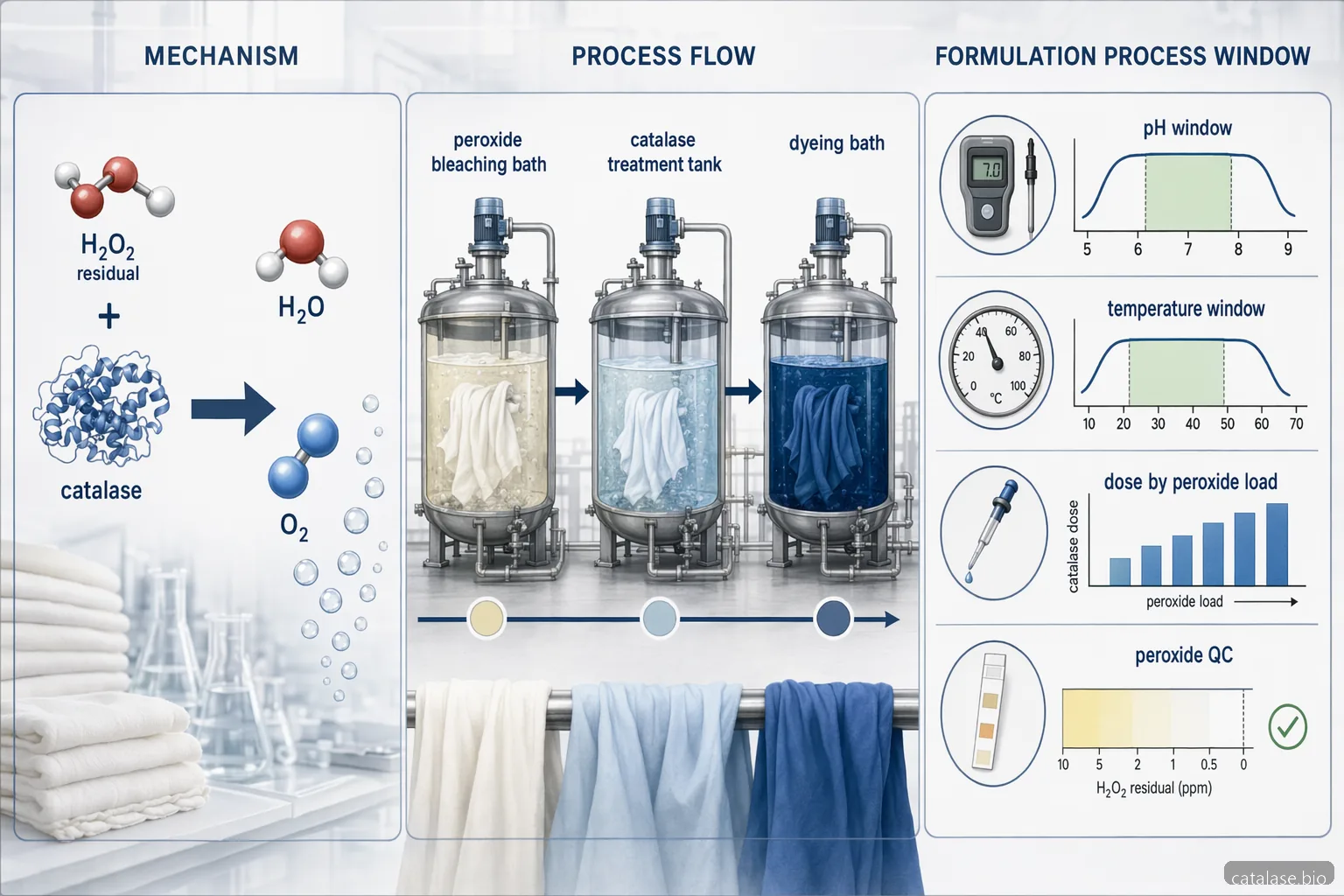
Most textile catalase enzyme systems are formulated for moderate conditions rather than strongly alkaline peroxide-bleach conditions. A practical starting window is pH 5.5-8.5, temperature 25-55°C, and contact time of 10-20 minutes, with agitation sufficient for bath uniformity. Some catalase enzymes tolerate broader ranges, but high caustic, high peroxide concentration, heavy metals, oxidizing biocides, or prolonged heat can reduce activity. In formulation work, adjust the bath after bleaching to the enzyme supplier’s recommended pH before dosing catalase. Avoid adding catalase directly into hot, highly alkaline bleach liquor unless the TDS specifically supports it. For continuous processing, validate dwell time, pick-up, fabric speed, and peroxide load across the full width of the line. For exhaust systems, confirm that liquor ratio and load size do not create dead zones where peroxide remains.
Starting pH: 5.5-8.5 • Starting temperature: 25-55°C • Typical contact time: 10-20 minutes • Confirm final conditions with the supplier TDS
Dosage strategy and cost-in-use
Catalase dosage should be based on residual hydrogen peroxide, enzyme activity, bath volume, fabric weight, and target cleanup time. As a screening range, formulators may evaluate 0.02-0.30% owg or 20-300 mL per 1,000 L of bath for liquid products, depending on activity and peroxide level. These bands are not a purchase specification; they are a pilot starting point. The COA should state the activity method or unit basis so the formulation team can compare lots and suppliers consistently. Cost-in-use should include enzyme price, dose, bath time, rinse reduction, water and energy savings, rework risk, and dye shade consistency. The lowest price per kilogram is not always the lowest operating cost. A concentrated, stable enzyme catalase preparation may deliver better economics if it lowers dose variation and simplifies inventory handling.
Dose to residual peroxide, not only bath volume • Compare suppliers on activity-normalized cost • Include water, energy, time, and rework in cost-in-use
QC checks for hydrogen peroxide removal
A catalase bleach cleanup step should have a simple, repeatable QC plan. Before dosing, measure residual hydrogen peroxide using titration, validated peroxide test strips, or an in-line method if available. After catalase treatment, confirm peroxide is below the mill’s internal limit for the dye class and shade depth. Many dyeing operations target near-zero detectable peroxide before reactive dye addition, but the acceptable value should be validated for the recipe. Track pH, temperature, time, fabric load, and catalase lot number in the batch record. Foaming can occur because oxygen is released during the reaction, so pilot work should assess antifoam compatibility and tank headspace. If peroxide remains high, check whether pH or temperature was outside range, enzyme was overdiluted or stored poorly, or bleach chemistry carried inhibitors into the cleanup bath.
Check peroxide before and after catalase • Record pH, temperature, time, and lot number • Validate peroxide limit by dye system and shade
Supplier qualification for catalase enzyme buyers
Industrial buyers should qualify catalase enzyme suppliers with documentation, technical support, and repeatable lot performance. Request the COA for activity and lot traceability, the TDS for recommended application conditions, and the SDS for safe handling, storage, spill response, and transport information. The supplier should describe storage temperature, shelf life, packaging options, preservative system if relevant, and compatibility limits with surfactants, chelants, salts, alkali, and other auxiliaries. Pilot validation should use production fabrics, actual bleach recipes, mill water, and the same dosing equipment intended for scale-up. Retain samples from approved lots to support troubleshooting. Avoid relying on unsupported claims about universal compatibility or guaranteed rinse elimination. A good supplier qualification process compares catalase enzymes through performance data, cost-in-use, logistics reliability, documentation quality, and responsiveness during scale-up.
Request COA, TDS, and SDS before approval • Run pilot trials with real mill conditions • Retain approved-lot samples for troubleshooting • Evaluate documentation and technical response
Formulation notes and compatibility
When designing catalase cleanup formulations, treat the enzyme as an active biological catalyst, not as a commodity neutralizing salt. Dilution water should be clean and within the recommended pH range. Avoid unnecessary exposure to strong oxidizers, high temperatures, or extreme pH before use. If the product is blended into an auxiliary formulation, test storage stability at intended concentration, packaging material, and warehouse temperatures. Preservatives, dispersants, wetting agents, and antifoams should be screened for enzyme compatibility. The phrase “enzymes and catalase” often appears in general science content, and “this membranous organelle contains oxidase and catalase enzymes” refers to peroxisomes in cells; industrial textile use is different. For mills, what do catalase enzymes do is practical: they remove residual hydrogen peroxide quickly enough to protect dyeing performance and reduce avoidable rinse demand.
Screen auxiliaries for enzyme compatibility • Validate storage stability in the final blend • Keep industrial use separate from health or supplement claims
Technical Buying Checklist
Buyer Questions
Yes. Catalase is an enzyme used industrially to break down hydrogen peroxide into water and oxygen. In textile mills, catalase enzyme is commonly applied after peroxide bleaching to reduce peroxide carryover before dyeing or finishing. It is not used as a medical supplement in this context. Buyers should evaluate activity, pH and temperature range, storage stability, and process compatibility.
Catalase enzymes accelerate the decomposition of residual hydrogen peroxide left in fabric or process liquor after bleaching. This helps prevent peroxide from interfering with dyes and auxiliaries. The result can be fewer rinses, shorter processing time, and more consistent dyeing, but performance must be verified by peroxide testing, pilot trials, and comparison against the mill’s current cleanup process.
Start with the supplier’s TDS and run a pilot based on residual peroxide, bath volume, fabric weight, liquor ratio, and required cleanup time. A broad screening range may be 0.02-0.30% owg or 20-300 mL per 1,000 L for some liquid products. Final dosage should be set by peroxide endpoint testing, lot activity on the COA, and cost-in-use.
A qualified supplier should provide a COA for activity and lot traceability, a TDS with application conditions and dosage guidance, and an SDS with handling and storage information. Buyers may also request shelf-life data, packaging details, allergen or food-contact relevance where applicable, and technical support for pilot validation. Avoid approving products on price alone without documentation.
Catalase can reduce the need for repeated peroxide-removal rinses, but it should not be assumed to eliminate every rinse in every process. Fabric construction, bleach recipe, alkali level, residual salts, surfactants, and dye sensitivity all affect the final workflow. Validate rinse reduction through pilot and production trials, then confirm peroxide endpoint, dye shade, fastness, hand feel, and wastewater impact.
Catalase for Research & Industry
Need Catalase for your lab or production process?
ISO 9001 certified · Food-grade & research-grade · Ships to 80+ countries
Frequently Asked Questions
Is catalase an enzyme used in textile processing?
Yes. Catalase is an enzyme used industrially to break down hydrogen peroxide into water and oxygen. In textile mills, catalase enzyme is commonly applied after peroxide bleaching to reduce peroxide carryover before dyeing or finishing. It is not used as a medical supplement in this context. Buyers should evaluate activity, pH and temperature range, storage stability, and process compatibility.
What do catalase enzymes do in bleach cleanup?
Catalase enzymes accelerate the decomposition of residual hydrogen peroxide left in fabric or process liquor after bleaching. This helps prevent peroxide from interfering with dyes and auxiliaries. The result can be fewer rinses, shorter processing time, and more consistent dyeing, but performance must be verified by peroxide testing, pilot trials, and comparison against the mill’s current cleanup process.
How should I dose enzyme catalase in a production bath?
Start with the supplier’s TDS and run a pilot based on residual peroxide, bath volume, fabric weight, liquor ratio, and required cleanup time. A broad screening range may be 0.02-0.30% owg or 20-300 mL per 1,000 L for some liquid products. Final dosage should be set by peroxide endpoint testing, lot activity on the COA, and cost-in-use.
What documents should catalase enzyme suppliers provide?
A qualified supplier should provide a COA for activity and lot traceability, a TDS with application conditions and dosage guidance, and an SDS with handling and storage information. Buyers may also request shelf-life data, packaging details, allergen or food-contact relevance where applicable, and technical support for pilot validation. Avoid approving products on price alone without documentation.
Can catalase replace all rinsing after peroxide bleaching?
Catalase can reduce the need for repeated peroxide-removal rinses, but it should not be assumed to eliminate every rinse in every process. Fabric construction, bleach recipe, alkali level, residual salts, surfactants, and dye sensitivity all affect the final workflow. Validate rinse reduction through pilot and production trials, then confirm peroxide endpoint, dye shade, fastness, hand feel, and wastewater impact.
Related: Catalase for Peroxide Removal at Working Temperatures
Turn This Guide Into a Supplier Brief Request a catalase enzyme formulation review, COA/TDS/SDS package, and pilot trial plan for your textile bleach cleanup process. See our application page for Catalase for Peroxide Removal at Working Temperatures at /applications/activity-temperature-catalase/ for specs, MOQ, and a free 50 g sample.
Contact Us to Contribute