Leftover Hydrogen Peroxide in Etch and Bleach Water: Clearing It Before Metal Precipitation, Biological Treatment or Dyeing
Clear leftover hydrogen peroxide from circuit board etch water and dye-house bleach baths with catalase instead of sulfite or extra rinses.
Hydrogen peroxide is a workhorse oxidant in printed circuit board lines (micro-etching, electroless copper, electroless nickel stripping) and in the bleaching stage of a dye-house. Once the oxidation or etching step is finished, the water it leaves behind often still carries a high concentration of peroxide. If that water moves on untreated, the next unit pays for it. This page is for the wastewater contractor, circuit board plant or dye-house manager who is buying reducing chemicals or running extra rinses to get rid of that peroxide, and it ends with the four numbers to email us so we can match an enzyme grade and a starting dose.
What leftover peroxide costs you
Leftover peroxide does three kinds of damage downstream.
It poisons the biological stage: the strong oxidant directly kills the microbes in the activated sludge. • It spoils heavy-metal precipitation: it reacts with metal ions and makes bubbles, so the floc floats instead of settling, or it re-oxidises metal that had already precipitated and puts it back into solution. • It eats your chemicals: peroxide "indiscriminately consumes the reducing agent or complex breaker dosed afterward", and the chemical bill climbs.
In a dye-house the damage shows on the fabric. After a peroxide bleach, both the cloth and the water left in the machine hold a lot of peroxide, and if reactive dyeing starts straight away the peroxide attacks the colour-forming part of the dye, giving patchy colour, shade differences and wind marks. Peroxide that is not fully removed after bleaching hurts both level dyeing and colour fastness.
The outcome: peroxide gone in minutes, nothing added to the water
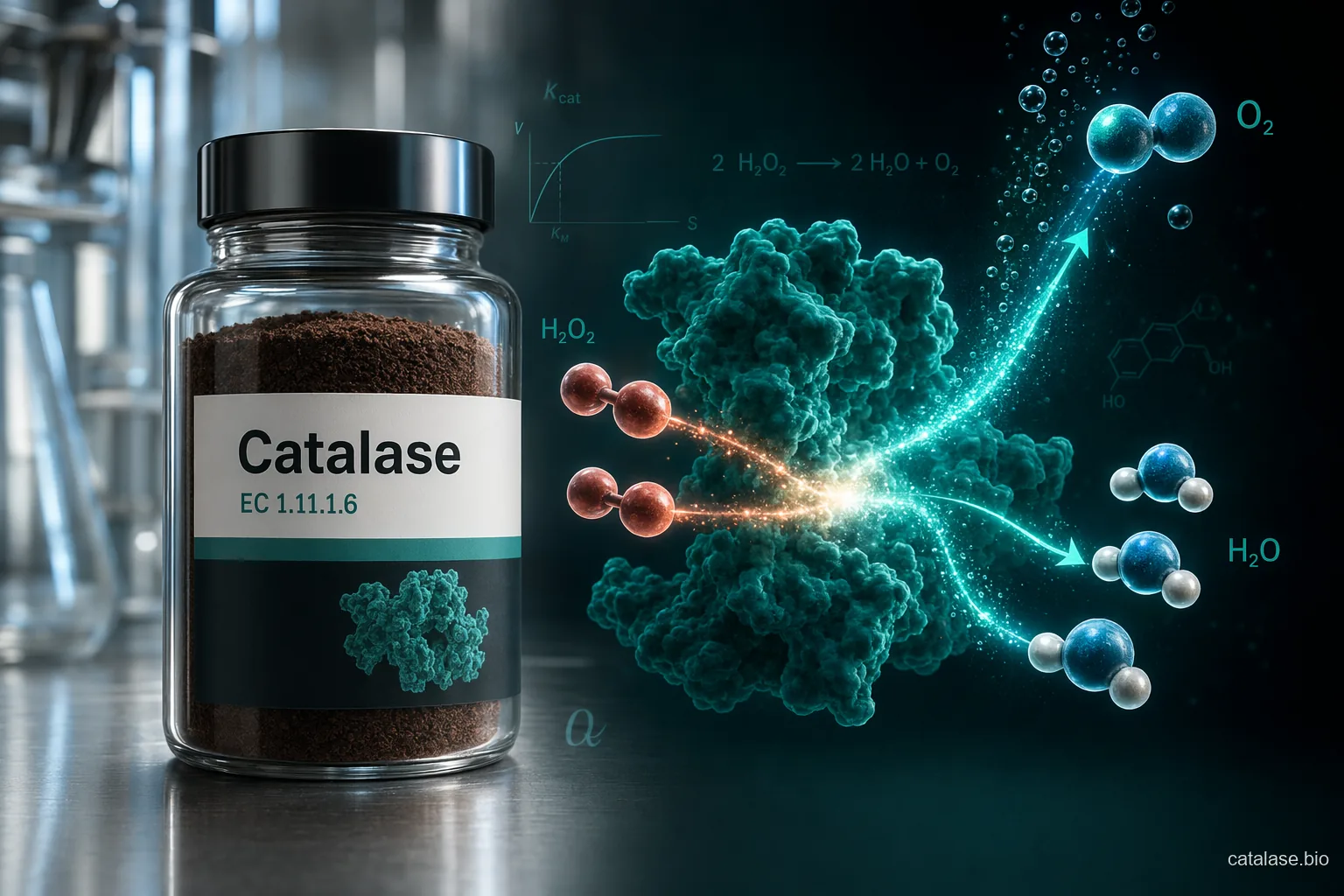
Catalase is an enzyme that splits hydrogen peroxide into plain water and oxygen. The reaction is 2 H2O2 -> 2 H2O + O2. It is among the fastest enzymes known, which is why a very small amount handles a large peroxide load. In micro-etch waste or bleach water, a trace dose of an industrial catalase, at the parts-per-million level, takes residual peroxide from thousands of ppm down to 0 ppm in 5 to 10 minutes. The reaction has no odour, forms no chemical precipitate and adds nothing to the dissolved solids of the water.
The business case against sulfite and extra rinses
The usual way to remove peroxide from wastewater is a chemical reducing agent: sodium bisulfite, sodium metabisulfite or sodium thiosulfate. In dye-houses the usual routes are hydrosulfite or thiosulfate, or several rinses. Each has a cost that does not show on the purchase order for the chemical itself.
How much you dose: a chemical reducing agent has to be overdosed at multiples of the calculated equivalent, so the chemical cost is high; repeated rinsing uses water, not chemical; catalase needs a trace, ppm-level dose. • Worker safety: sulfite can release irritating sulfur dioxide gas when the reaction is poorly controlled; rinsing gives no gas; catalase is non-toxic, with no odour. • What it leaves in the water: a reducing agent leaves a large amount of sulfate, so dissolved solids rise sharply and membranes downstream are at risk of scaling; rinsing leaves nothing, but a large rinse volume; catalase leaves water and oxygen only, with no rise in dissolved solids. • In the dye-house: a reducing agent leaves residue on the goods and a sulfur load in the wastewater; rinsing means several fills and drains before dyeing; catalase adds no salt, so dyeing can follow in the same bath or a shortened route. • Water and steam: unchanged with a reducing agent, highest with repeated rinsing; catalase saves a large amount of rinse water and steam.
For a plant that runs membranes after its chemical treatment, the sulfate point matters most: the sulfite used to kill peroxide comes back as salt the membrane has to reject. The reported total chemical cost per tonne of water treated is 35%-45% lower than the sodium bisulfite route; treat it as a figure to verify against your own chemical bill.
Circuit board lines: before breaking complexes and precipitating metals
The micro-etch step (persulfate and peroxide chemistry) and the stripping steps produce wastewater with a high peroxide content. Before electroless nickel or electroless copper wastewater is treated to break the metal complexes and precipitate the copper and nickel, any peroxide still present will quickly oxidise the sodium sulfide or heavy-metal scavenger you add, and it is wasted. The flow plants use is:
1. Collect the micro-etch or electroless nickel waste liquor. • 2. Dose catalase and let it clear the residual peroxide. • 3. Dose the complex breaker or heavy-metal scavenger. • 4. Precipitate the metals and discharge within your limit.
With the peroxide gone first, the complex breaker works on the metal complexes instead of on the oxidant, copper and nickel precipitate more completely, and the risk of a heavy-metal exceedance drops sharply.
Dye-houses: peroxide clean-up between bleaching and dyeing
There are two ways this step is run, and which one fits depends on your machine.
Batch machines, fresh fill. Drain the bath when scouring and bleaching are finished, refill, add catalase to the incoming water and run cold or warm for 5-10 minutes; once the peroxide reads zero, add the dyes to the same bath and start dyeing. As the practice is summed up on the dye-house floor: "no repeated rinsing: remove the oxygen and continue dyeing in the same bath".
Hot and continuous ranges. The step is run at 70-85 °C with a heat-tolerant catalase, at the natural pH of the bath or trimmed to pH 6.5-8.5, for 10-20 minutes. The enzyme dose is set by the residual peroxide concentration and is usually 0.5-2.0 g/L, lower for high-strength concentrated grades. A low-foam or self-defoaming formula cuts the defoamer you have to add, and a continuous range does not need to be cooled down again and again. On one continuous line this set-up shortened the peroxide-removal time and lowered steam use; confirm the size of that gain in your own pilot run, because it depends on the range.
Why an ordinary catalase fails in industrial water
This is the complaint we hear most, and the reason grade selection matters more than the label on the drum. Ordinary food-type or conventional fermentation catalase often does not survive industrial wastewater.
Heat: bleach liquor and circuit board process residues often leave the process hot, and an ordinary enzyme protein is quickly inactivated at that temperature. • Acid and alkali: micro-etch waste is strongly acidic, electroless nickel and bleach liquors are alkaline, and an ordinary enzyme only works in a narrow band around neutral pH, so you burn a lot of acid or alkali adjusting the water first. • Salt and metals: industrial wastewater often carries high salt and heavy metals, so resistance to poisoning has to be shown on your own liquor.
Industrial catalase therefore comes in two classes, and this is what separates them.
Working temperature: moderate heat only for a conventional industrial grade; 25-80 °C for a heat- and pH-tolerant grade. • Working pH: mildly acid to mildly alkaline for a conventional grade; pH 3.0-11.0 for a tolerant grade. • Highest peroxide strength tolerated: clearly lower for a conventional grade; up to 25,000 mg/L for a tolerant grade.
In testing, the tolerant type kept most of its activity through a sustained run in wastewater near the top of that temperature range, and held a high reaction rate across almost the whole of that pH range. What that buys the plant is fewer steps: hot, strongly acid or strongly alkaline water can be dosed directly, without cooling it first or neutralising it back and forth. For textile work, the heat-tolerant type still breaks down residual peroxide efficiently at 85 °C.
One case result is worth repeating in your own pilot: on high-strength micro-etch liquor from a large circuit board industrial park, carrying a peroxide load well inside the tolerance above, a side-by-side trial cleared the residual peroxide within the 5-10 minute range.
What goes wrong, and how to avoid it
1. Skipping the pilot: run a small-scale test and then a pilot batch on your own liquor or fabric before full production; different goods and recipes respond differently, and going straight to full scale is risky. • 2. Dosing by habit instead of by measurement: less is not better; the dose has to match the load and the equipment, so set it from the residual peroxide you measure. Too little leaves peroxide behind for the dye or the scavenger to meet, and too much is money down the drain. • 3. Ignoring the other chemicals in the bath: check the enzyme against your existing auxiliaries in the small-scale test, because surfactants can suppress enzyme activity. • 4. Hard water and metal ions: monitor water hardness and metal ion content, and add a chelating agent to protect the enzyme when needed. • 5. Buying a grade that needs protecting: an enzyme that runs directly on your existing hot equipment costs less overall than one that needs the water cooled for it. Precise control of temperature and pH also does more than simply raising the enzyme dose. • 6. Poor storage: keep liquid enzyme cool and sealed and avoid repeated freezing and thawing; keep powder dry. • 7. Choosing on the label alone: benchmark the candidate against a premium grade at the same temperature and pH, compare real remaining activity, dose and total cost, and decide on the small-scale and pilot data.
What to tell us when you email
Send us four numbers and we can match a grade and suggest a starting dose for your pilot test:
1. Temperature of the liquor at the point where you would dose. • 2. Its pH at that point. • 3. Residual hydrogen peroxide in mg/L, or your best estimate. • 4. Volume per batch or flow per hour.
It also helps to know what comes next (biological treatment, metal precipitation, membranes or dyeing), whether the water carries heavy metals or high salt, and which auxiliaries are already in the bath.
Liquid and powder forms are both used; tell us which your dosing equipment prefers.
Next step
Email us those figures and ask for a sample, a quote and dosing help for your first pilot run. We will reply with the grade we would start with, a dose range to test and the simple check to confirm the peroxide has reached zero before your next process step.
Catalase for Research & Industry
Need Catalase for your lab or production process?
ISO 9001 certified · Food-grade & research-grade · Ships to 80+ countries
Frequently Asked Questions
What does leftover hydrogen peroxide do to wastewater treatment?
It poisons the biological stage: the strong oxidant directly kills the microbes in the activated sludge. It spoils heavy-metal precipitation: it reacts with metal ions and makes bubbles, so the floc floats instead of settling, or it re-oxidises metal that had already precipitated and puts it back into solution.
How fast does catalase remove residual peroxide?
In micro-etch waste or bleach water, a trace dose of an industrial catalase, at the parts-per-million level, takes residual peroxide from thousands of ppm down to 0 ppm in 5 to 10 minutes. The reaction has no odour, forms no chemical precipitate and adds nothing to the dissolved solids of the water.
Why does an ordinary catalase fail in industrial water?
Bleach liquor and circuit board process residues often leave the process hot, and an ordinary enzyme protein is quickly inactivated at that temperature. Micro-etch waste is strongly acidic, electroless nickel and bleach liquors are alkaline, and an ordinary enzyme only works in a narrow band around neutral pH, so you burn a lot of acid or alkali adjusting the water first.
How is catalase run on a hot or continuous textile range?
The step is run at 70-85 °C with a heat-tolerant catalase, at the natural pH of the bath or trimmed to pH 6.5-8.5, for 10-20 minutes. The enzyme dose is set by the residual peroxide concentration and is usually 0.5-2.0 g/L, lower for high-strength concentrated grades.
What should I send to get a grade and dose suggestion?
Send us four numbers and we can match a grade and suggest a starting dose for your pilot test: the temperature of the liquor at the point where you would dose, its pH at that point, the residual hydrogen peroxide in mg/L, or your best estimate, and the volume per batch or flow per hour.
Clearing leftover peroxide from etch or bleach water?
Email us those figures and ask for a sample, a quote and dosing help for your first pilot run. We will reply with the grade we would start with, a dose range to test and the simple check to confirm the peroxide has reached zero before your next process step.
Contact Us to Contribute